
LM2459
LM2459 is Monolithic Single Channel 15MHz DTV CRT Driver manufactured by Texas Instruments.
FEATURES
- 2 15MHz Bandwidth at 130VPP Output Swing
- 0V to 4V Input Range
- Greater than 130VPP Output Swing Capability
- Stable With 0- 20 p F Capacitive Loads and
Inductive Peaking Networks
- Transient Response Improvement Option Via
Pin 6 (EM)
APPLICATIONS
- AC Coupled DTV Applications Using the 480p Format as well as Standard NTSC and PAL Formats
DESCRIPTION
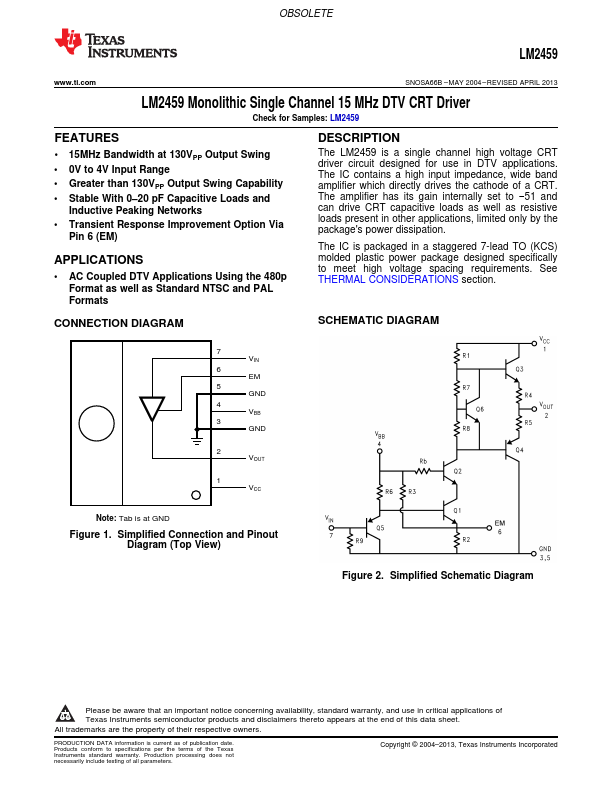
The LM2459 is a single channel high voltage CRT driver circuit designed for use in DTV applications. The IC contains a high input impedance, wide band amplifier which directly drives the cathode of a CRT. The amplifier has its gain internally set to
- 51 and can drive CRT capacitive loads as well as resistive loads present in other applications, limited only by the package's power dissipation.
The IC is packaged in a staggered 7-lead TO (KCS) molded plastic power package designed specifically to meet high voltage spacing requirements. See THERMAL CONSIDERATIONS section.
CONNECTION DIAGRAM
SCHEMATIC DIAGRAM
7 VIN
6 EM
5 GND
4 VBB
3 GND
2 VOUT
1 VCC
Note: Tab is at GND
Figure 1. Simplified Connection and Pinout Diagram (Top View)
Figure 2. Simplified Schematic Diagram
Please be aware that an important notice concerning availability, standard warranty, and use in critical applications of Texas Instruments semiconductor products and disclaimers thereto appears at the end of this data sheet. All trademarks are the property of their respective owners.
PRODUCTION DATA information is current as of publication date. Products conform to specifications per the terms of the Texas Instruments standard warranty. Production processing does not necessarily include testing of all parameters.
Copyright © 2004- 2013, Texas Instruments Incorporated
OBSOLETE
SNOSA66B
- MAY 2004
- REVISED APRIL 2013
.ti.
These devices have limited built-in ESD protection. The leads should be shorted together or the device placed in conductive foam during storage or handling to prevent electrostatic damage to the MOS...