
CD74HCT40105
CD74HCT40105 is 4-Bit x 16-Word FIFO Register manufactured by Texas Instruments.
- Part of the CD74HC40105 comparator family.
- Part of the CD74HC40105 comparator family.
Features
Description
- Independent Asynchronous Inputs and Outputs
- Expandable in Either Direction
- Reset Capability
- Status Indicators on Inputs and Outputs
- Three-State Outputs
- Shift-Out Independent of Three-State Control
- Fanout (Over Temperature Range)
- Standard Outputs
- -
- 10 LSTTL Loads
- Bus Driver Outputs
- - . . . 15 LSTTL Loads
- Wide Operating Temperature Range . . . -55o C to 125o C
- Balanced Propagation Delay and Transition Times
- Significant Power Reduction pared to LSTTL Logic ICs
- HC Types
- 2V to 6V Operation
- High Noise Immunity: NIL = 30%, NIH = 30% of VCC at VCC = 5V
- HCT Types
- 4.5V to 5.5V Operation
- Direct LSTTL Input Logic patibility, VIL= 0.8V (Max), VIH = 2V (Min)
- CMOS Input patibility, Il ≤ 1µA at VOL, VOH
Applications
- Bit-Rate Smoothing
- CPU/Terminal Buffering
- Data munications
- Peripheral Buffering
- Line Printer Input Buffers
- Auto-Dialers
- CRT Buffer Memories
- Radar Data Acquisition
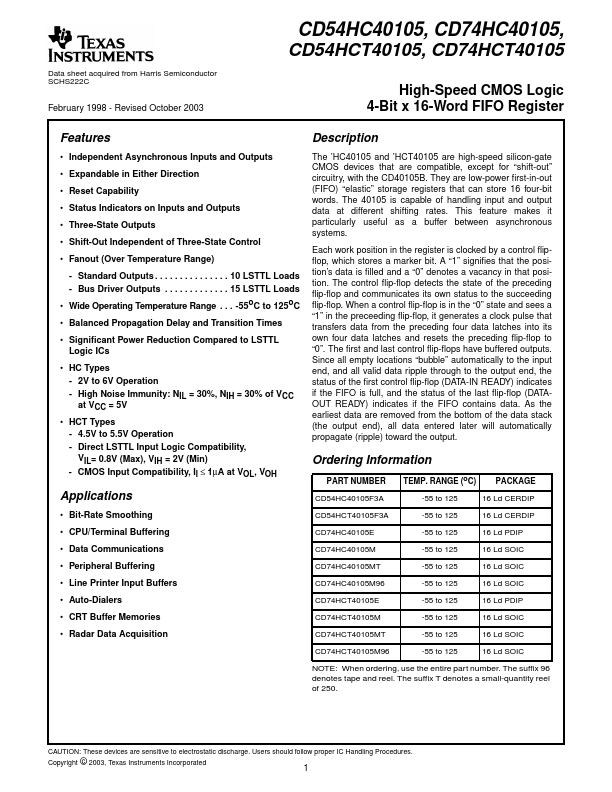
The ’HC40105 and ’HCT40105 are high-speed silicon-gate CMOS devices that are patible, except for “shift-out” circuitry, with the CD40105B. They are low-power first-in-out (FIFO) “elastic” storage registers that can store 16 four-bit words. The 40105 is capable of handling input and output data at different shifting rates. This feature makes it particularly useful as a buffer between asynchronous systems.
Each work position in the register is clocked by a control flipflop, which stores a marker bit. A “1” signifies that the position’s data is filled and a “0” denotes a vacancy in that position. The control flip-flop detects the state of the preceding flip-flop and municates its own status to the succeeding flip-flop. When a control flip-flop is in the “0” state and sees a “1” in the preceeding flip-flop, it generates a clock pulse that transfers data from the preceding four data latches into its own four data latches and resets the preceding flip-flop to “0”. The first and last control flip-flops have buffered...