Datasheet4U Logo Datasheet4U.com

ADS8685 - SAR ADC Data Acquisition

Download the ADS8685 datasheet PDF. This datasheet also covers the ADS8681 variant, as both devices belong to the same sar adc data acquisition family and are provided as variant models within a single manufacturer datasheet.

General Description

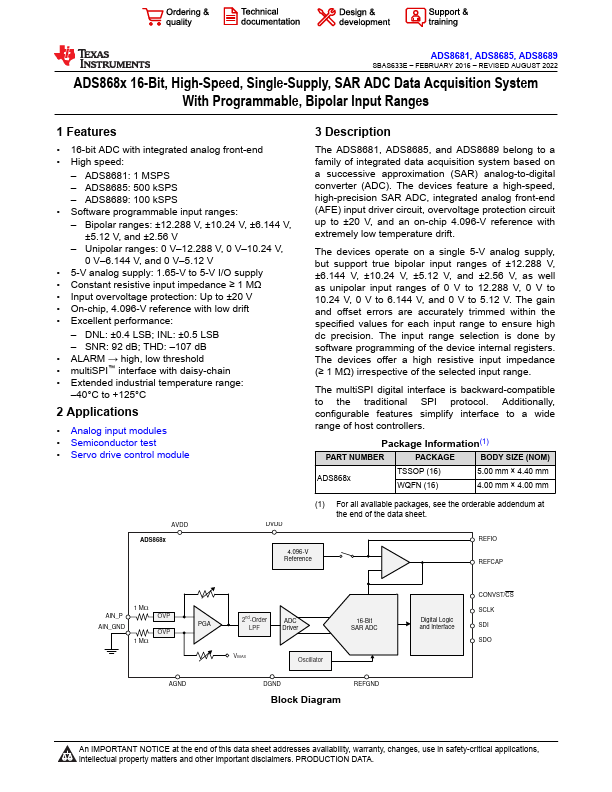
The ADS8681, ADS8685, and ADS8689 belong to a family of integrated data acquisition system based on a successive approximation (SAR) analog-to-digital converter (ADC).

Key Features

  • 16-bit ADC with integrated analog front-end.
  • High speed:.
  • ADS8681: 1 MSPS.
  • ADS8685: 500 kSPS.
  • ADS8689: 100 kSPS.
  • Software programmable input ranges:.
  • Bipolar ranges: ±12.288 V, ±10.24 V, ±6.144 V, ±5.12 V, and ±2.56 V.
  • Unipolar ranges: 0 V.
  • 12.288 V, 0 V.
  • 10.24 V, 0 V.
  • 6.144 V, and 0 V.
  • 5.12 V.
  • 5-V analog supply: 1.65-V to 5-V I/O supply.
  • Constant resistive input impedance ≥ 1 M.

📥 Download Datasheet

Note: The manufacturer provides a single datasheet file (ADS8681-etcTI.pdf) that lists specifications for multiple related part numbers.

Full PDF Text Transcription (Reference)

The following content is an automatically extracted verbatim text from the original manufacturer datasheet and is provided for reference purposes only.

View original datasheet text
ADS8681, ADS8685, ADS8689 SBAS633E – FEBRUARY 2016 – REVISED AUGUST 2022 ADS868x 16-Bit, High-Speed, Single-Supply, SAR ADC Data Acquisition System With Programmable, Bipolar Input Ranges 1 Features • 16-bit ADC with integrated analog front-end • High speed: – ADS8681: 1 MSPS – ADS8685: 500 kSPS – ADS8689: 100 kSPS • Software programmable input ranges: – Bipolar ranges: ±12.288 V, ±10.24 V, ±6.144 V, ±5.12 V, and ±2.56 V – Unipolar ranges: 0 V–12.288 V, 0 V–10.24 V, 0 V–6.144 V, and 0 V–5.12 V • 5-V analog supply: 1.65-V to 5-V I/O supply • Constant resistive input impedance ≥ 1 MΩ • Input overvoltage protection: Up to ±20 V • On-chip, 4.096-V reference with low drift • Excellent performance: – DNL: ±0.4 LSB; INL: ±0.