
Datasheet Details
| Part number | SM15T15A |
|---|---|
| Manufacturer | Vishay |
| File Size | 108.55 KB |
| Description | Surface Mount Transient Voltage Suppressors |
| Datasheet |
 SM15T15A Datasheet SM15T15A Datasheet
|
|
|

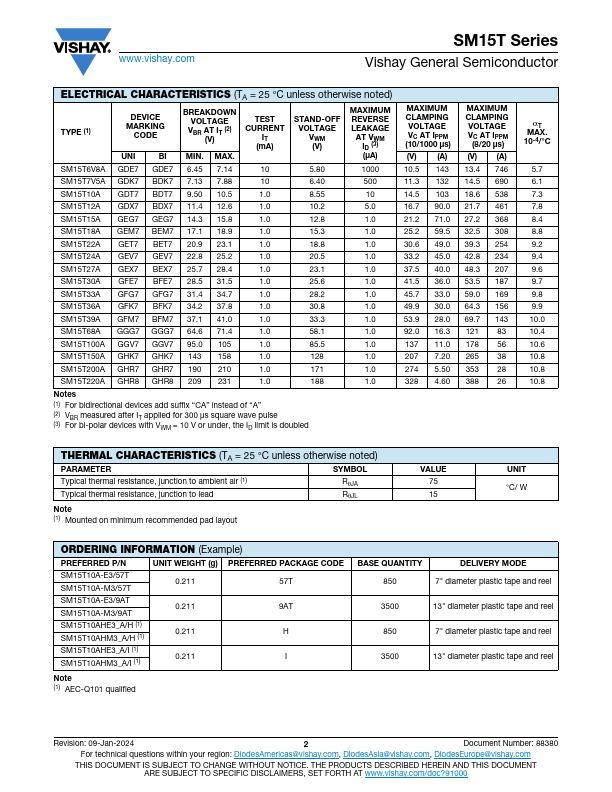
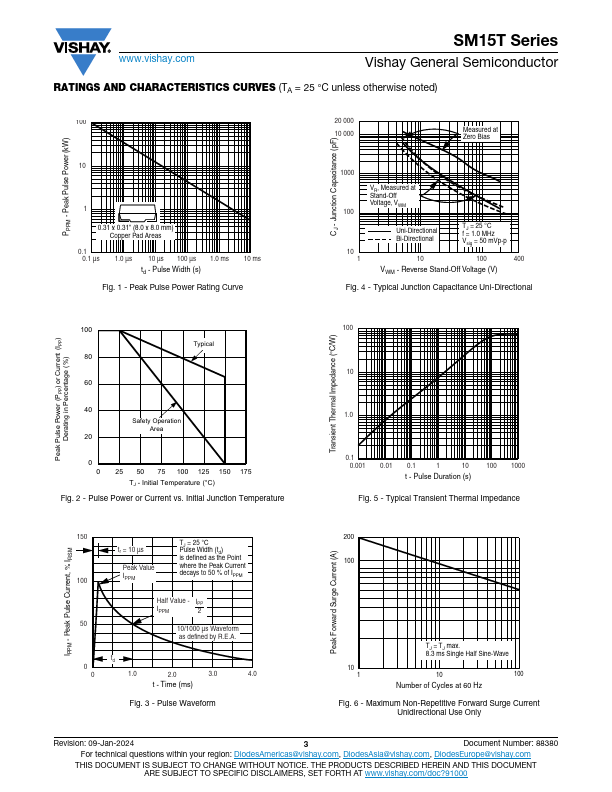
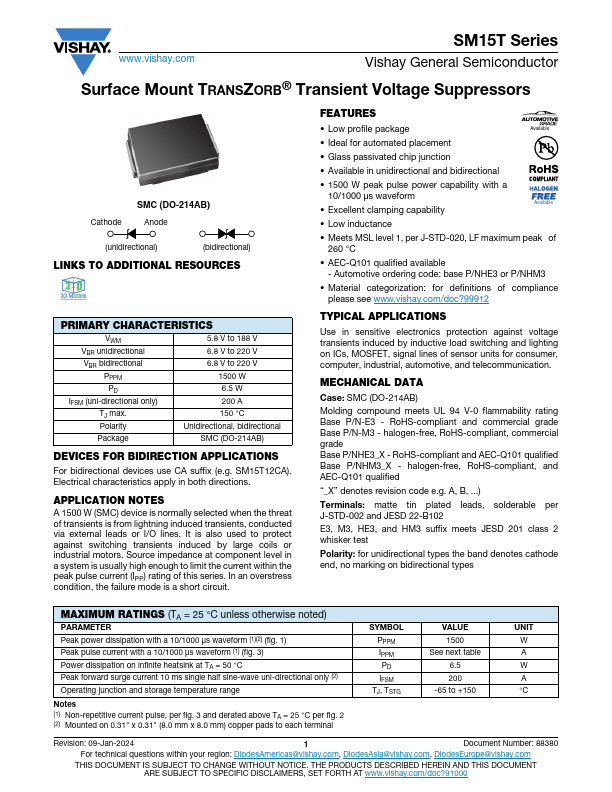
Download the SM15T15A datasheet PDF. This datasheet also covers the SM15T variant, as both devices belong to the same surface mount transient voltage suppressors family and are provided as variant models within a single manufacturer datasheet.
| Part number | SM15T15A |
|---|---|
| Manufacturer | Vishay |
| File Size | 108.55 KB |
| Description | Surface Mount Transient Voltage Suppressors |
| Datasheet |
SM15T15A Datasheet
|
|
|
|
| Part Number | Description | Manufacturer |
|---|---|---|
| SM15T15A | 1500w TVS | STMicroelectronics |
| SM15T15A | SURFACE MOUNT TRANSIENT VOLTAGE SUPPRESSOR | SunMate |
| SM15T15A | TRANSZORB SURFACE MOUNT TRANSIENT VOLTAGE SUPPRESSOR | General Semiconductor |
| SM15T15AY | Automotive 1500W TVS | STMicroelectronics |
| SM15T150A | SURFACE MOUNT TRANSIENT VOLTAGE SUPPRESSOR | SunMate |
| Part Number | Description |
|---|---|
| SM15T150A | Surface Mount Transient Voltage Suppressors |
| SM15T100A | Surface Mount Transient Voltage Suppressors |
| SM15T10A | Surface Mount Transient Voltage Suppressors |
| SM15T12A | Surface Mount Transient Voltage Suppressors |
| SM15T18A | Surface Mount Transient Voltage Suppressors |
The following content is an automatically extracted verbatim text from the original manufacturer datasheet and is provided for reference purposes only.