TQ5635
TQ5635 is 1840 - 1870 MHz KPCS CDMA Mixer Receiver manufactured by TriQuint Semiconductor.
Features
? ? Single 3.0 V Operation ? ? Adjustable Gain/IP3/Current ? ? Low Current Operation ? ? Few external ponents ? ? QFN 3x3 mm, 16 Pin Leadless Plastic Package ? ? High Input IP3 ? ? Low Noise Figure
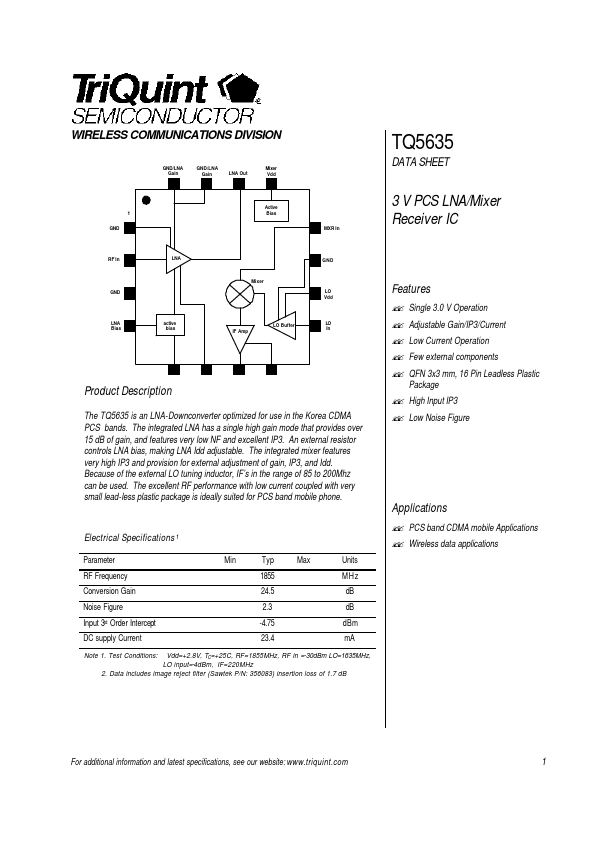
LNA Bias active bias
LO Buffer IF Amp
LO In
LNA Vdd
IF Out
Product Description
The TQ5635 is an LNA-Downconverter optimized for use in the Korea CDMA PCS bands. The integrated LNA has a single high gain mode that provides over 15 d B of gain, and features very low NF and excellent IP3. An external resistor controls LNA bias, making LNA Idd adjustable. The integrated mixer features very high IP3 and provision for external adjustment of gain, IP3, and Idd. Because of the external LO tuning inductor, IF’s in the range of 85 to 200Mhz can be used. The excellent RF performance with low current coupled with very small lead-less plastic package is ideally suited for PCS band mobile phone.
.Data Sheet.net/
Applications
? ? PCS band CDMA mobile Applications ? ? Wireless data applications
Electrical Specifications 1
Parameter RF Frequency Conversion Gain Noise Figure Input 3rd Order Intercept DC supply Current
Note 1. Test Conditions:
Min
Typ 1855 24.5 2.3 -4.75 23.4
Max
Units MHz d B d B d Bm m A
Vdd=+2.8V, TC=+25C, RF=1855MHz, RF in =-30d Bm LO=1635MHz, LO input=-4d Bm, IF=220MHz 2. Data includes image reject filter (Sawtek P/N: 356083) insertion loss of 1.7 d B
For additional information and latest specifications, see our website: .triquint.
Datasheetpdf-http://..co.kr/
TQ5635 Data Sheet
Absolute Maximum Ratings
Parameter Storage Temperature Case Temperature w/bias Supply Voltage Voltage to any non supply pin Power Dissipation Signal Power Symbol Tstore Tc VDD P Ps Minimum -40 -40 0 Nominal 25 25 2.8 Maximum 125 85 5.0 100 20 Units deg. C deg. C V VDD+0.5V m W d Bm
Note 1. All voltages are measured with respect to GND (0V), and they are continuous. 2. Absolute maximum ratings as detailed in this table, are ratings beyond which the device’s...