

TCR3DF11
TCR3DF11 is 300mA CMOS Low Drop-Out Regulator manufactured by Toshiba.
- Part of the TCR3DF10 comparator family.
feature over-current protection, over-temperature protection, Inrush current protection circuit and Auto-discharge function.
The TCR3DF series has a low dropout voltage of 230 m V (2.5 V output, IOUT = 300 m A) with low output noise voltage of 38 µVrms (2.5 V output) and a load transient response of only ⊿VOUT = ±85 m V ( IOUT = 1 m A⇔300 m A, COUT =1.0 µF).
Thus, the TCR3DF series are suitable for sensitive power supply such as Analog and RF applications.
Features
Weight : SMV (SOT-25)(SC-74A) : 16 mg ( typ.)
- Low Drop-Out voltage VIN-VOUT = 230 m V (typ.) at 2.5 V-output, IOUT = 300 m A VIN-VOUT = 290 m V (typ.) at 1.8 V-output, IOUT = 300 m A VIN-VOUT = 510 m V (typ.) at 1.2 V-output, IOUT = 300 m A
- Low output noise voltage VNO = 38 µVrms (typ.) at 2.5 V-output, IOUT = 10 m A, 10 Hz <= f <= 100 k Hz
- Fast load transient response (⊿VOUT = ±85 m V (typ.) at IOUT = 1 ⇔ 300 m A, COUT =1.0 µF )
- High ripple rejection ( R.R = 70 d B (typ.) at 2.5V-output, IOUT = 10 m A, f =1k Hz )
- Over-current protection
- Over-temperature protection
- Inrush current protection circuit
- Auto-discharge function
- Pull down connection between CONTROL and GND
- Ceramic capacitors can be used ( CIN = 1.0µF, COUT =1.0 µF )
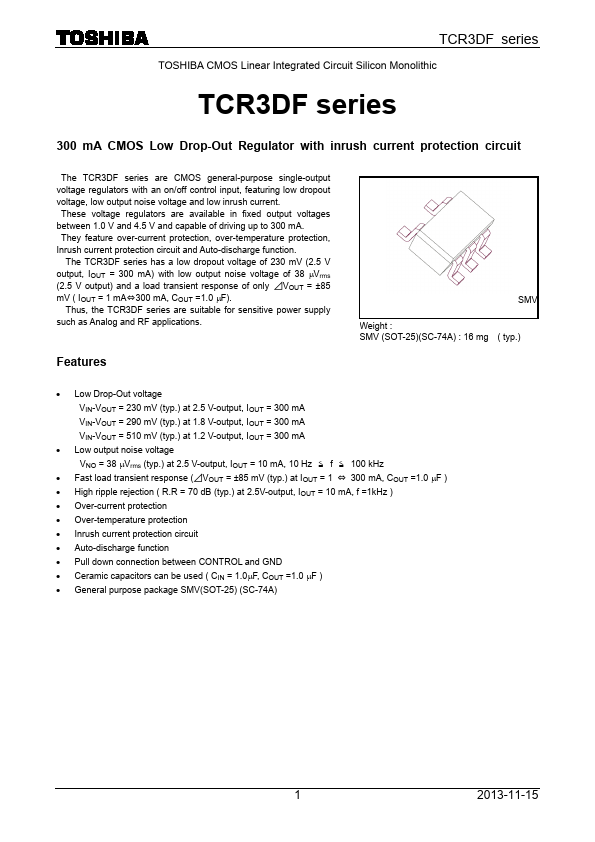
- General purpose package SMV(SOT-25) (SC-74A)
1 2013-11-15
Absolute Maximum Ratings (Ta = 25°C)
Characteristics Input voltage Control voltage Output voltage Output current
Power dissipation
Operation temperature range Junction temperature Storage temperature range
Symbol
VIN VCT VOUT IOUT
Topr Tj Tstg
Rating
6.0 -0.3 to 6.0 -0.3 to VIN + 0.3
300 200 (Note1) 580 (Note2)
- 40 to 85 150
- 55 to 150
Unit V V V m A m W
°C °C °C
TCR3DF series
Note:
Using continuously under heavy loads (e.g. the application of high temperature/current/voltage and the significant change in temperature, etc.) may cause this product to decrease in the reliability significantly even if the operating conditions (i.e. operating temperature/current/voltage, etc.) are within the absolute maximum...