
Datasheet Details
| Part number | TC518512FL-10DR |
|---|---|
| Manufacturer | Toshiba |
| File Size | 315.88 KB |
| Description | SILICON GATE CMOS PSEUDO STATIC RAM |
| Datasheet |
 TC518512FL-10DR Datasheet TC518512FL-10DR Datasheet
|
|
|

Download the TC518512FL-10DR datasheet PDF. This datasheet also covers the TC518512PL-70DR variant, as both devices belong to the same silicon gate cmos pseudo static ram family and are provided as variant models within a single manufacturer datasheet.
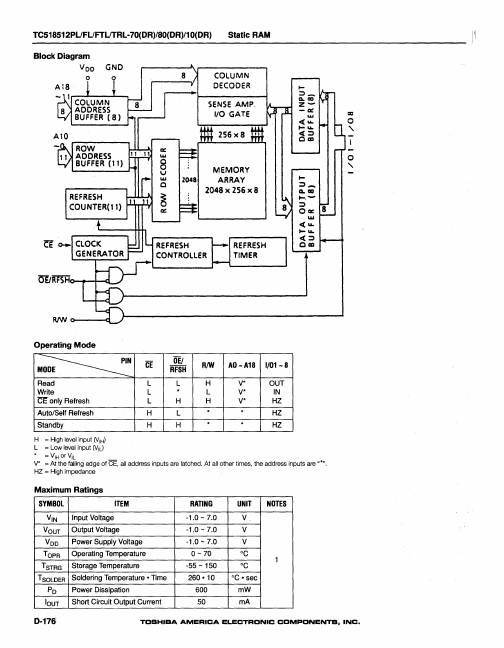
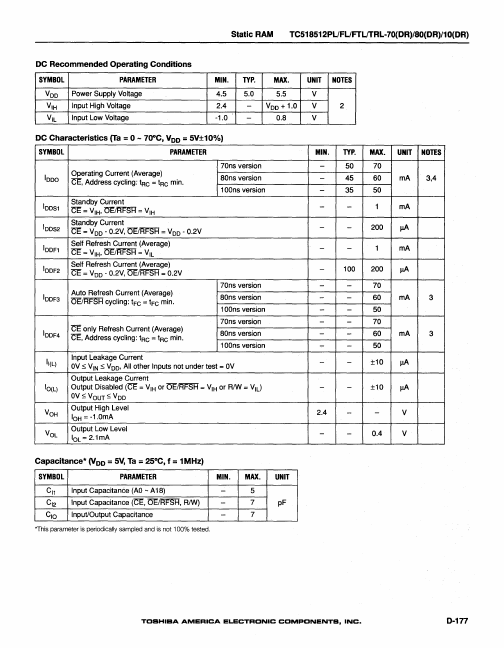
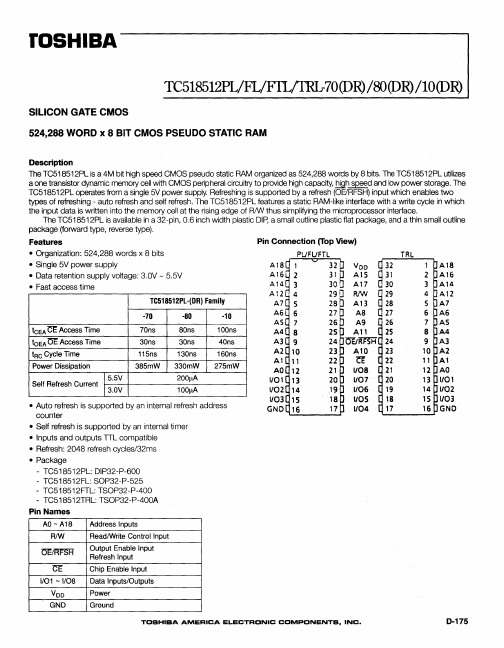
The TC518512PL is a 4M bit high speed CMOS pseudo static RAM organized as 524,288 words by 8 bits.
The TC518512PL utilizes a one transistor dynamic memory cell with CMOS peripheral circuitry to provide high capacity, .!J!gh speed and low power storage.
| Part number | TC518512FL-10DR |
|---|---|
| Manufacturer | Toshiba |
| File Size | 315.88 KB |
| Description | SILICON GATE CMOS PSEUDO STATIC RAM |
| Datasheet |
TC518512FL-10DR Datasheet
|
|
|
|
| Part Number | Description | Manufacturer |
|---|---|---|
| TC51 | 1uA Voltage Detector | Microchip |
| TC510 | Precision Analog Front Ends | Microchip |
| TC510 | (TC5xx) PRECISION ANALOG FRONT ENDS | TelCom Semiconductor |
| TC511402 | 1048576 x 4 BIT DYNAMIC RAM | Toshiba Semiconductor |
| TC511402AJ-60 | DRAM | Toshiba Semiconductor |
| Part Number | Description |
|---|---|
| TC518512FL-10 | SILICON GATE CMOS PSEUDO STATIC RAM |
| TC518512FL-10LT | SILICON GATE CMOS PSEUDO STATIC RAM |
| TC518512FL-10LV | SILICON GATE CMOS PSEUDO STATIC RAM |
| TC518512FL-70 | SILICON GATE CMOS PSEUDO STATIC RAM |
| TC518512FL-70DR | SILICON GATE CMOS PSEUDO STATIC RAM |
The following content is an automatically extracted verbatim text from the original manufacturer datasheet and is provided for reference purposes only.