• Part: TB7107FN
  • Description: Buck DC-DC Converter
  • Manufacturer: Toshiba
  • Size: 345.08 KB
Download TB7107FN Datasheet PDF
Toshiba
TB7107FN
TB7107FN is Buck DC-DC Converter manufactured by Toshiba.
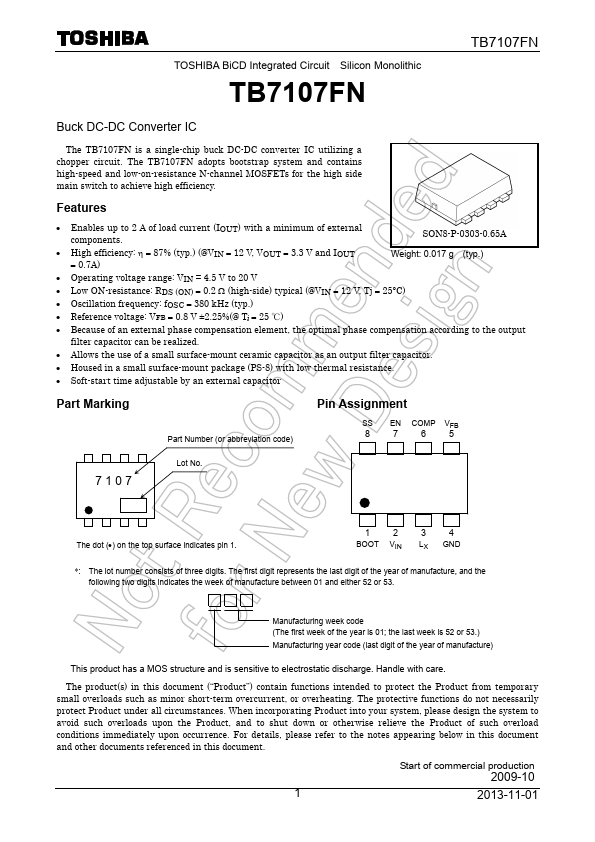
Features - Enables up to 2 A of load current (IOUT) with a minimum of external ponents. SON8-P-0303-0.65A - High efficiency: η = 87% (typ.) (@VIN = 12 V, VOUT = 3.3 V and IOUT = 0.7A) Weight: 0.017 g (typ.) - Operating voltage range: VIN = 4.5 V to 20 V - Low ON-resistance: RDS (ON) = 0.2 Ω (high-side) typical (@VIN = 12 V, Tj = 25°C) - Oscillation frequency: f OSC = 380 k Hz (typ.) - Reference voltage: VFB = 0.8 V ±2.25%(@ Tj = 25 ℃) - Because of an external phase pensation element, the optimal phase pensation according to the output filter capacitor can be realized. - Allows the use of a small surface-mount ceramic capacitor as an output filter capacitor. - Housed in a small surface-mount package (PS-8) with low thermal resistance. - Soft-start time adjustable by an external capacitor Part Marking Part Number (or abbreviation code) Pin Assignment SS EN P VFB Lot No. The dot (- ) on the top surface indicates pin 1. BOOT VIN LX GND - : The lot number consists of three digits. The first digit represents the last digit of the year of manufacture, and the following two digits indicates the week of manufacture between 01 and either 52 or 53. Manufacturing week code (The first week of the year is 01; the last week is 52 or 53.) Manufacturing year code (last digit of the year of manufacture) This product has a MOS structure and is sensitive to electrostatic discharge. Handle with care. The product(s) in this document (“Product”) contain functions intended to protect the Product from temporary small overloads such as minor short-term overcurrent, or overheating. The protective functions do not necessarily protect Product under all circumstances. When incorporating Product into your system, please design the system to avoid such overloads upon the Product, and to shut down or otherwise relieve the Product of such overload conditions immediately upon occurrence. For details, please refer to the notes appearing below in this...