
Datasheet4U Logo Datasheet4U.com

SGRF303 - Non-Latching RF Relay

Download the SGRF303 datasheet PDF. This datasheet also covers the SGRF300 variant, as both devices belong to the same non-latching rf relay family and are provided as variant models within a single manufacturer datasheet.

Description

SGRF300 & SGRF303

Features

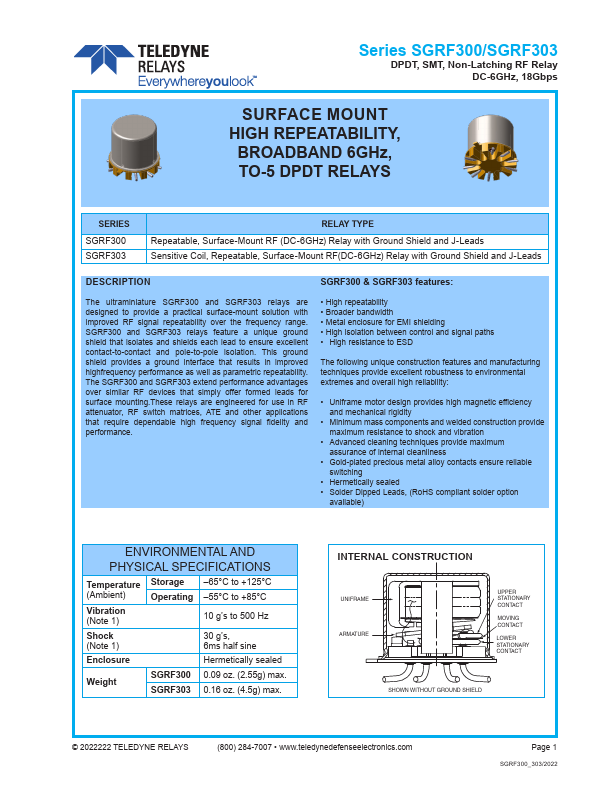
  • The ultraminiature SGRF300 and SGRF303 relays are designed to provide a practical surface-mount solution with improved RF signal repeatability over the frequency range. SGRF300 and SGRF303 relays feature a unique ground shield that isolates and shields each lead to ensure excellent contact-to-contact and pole-to-pole isolation. This ground shield provides a ground interface that results in improved highfrequency performance as well as parametric repeatability. The SGRF300 and SGRF303 extend pe.

📥 Download Datasheet

Note: The manufacturer provides a single datasheet file (SGRF300-Teledyne.pdf) that lists specifications for multiple related part numbers.

Datasheet Details

Part number SGRF303
Manufacturer Teledyne
File Size 1.28 MB
Description Non-Latching RF Relay
Datasheet download datasheet SGRF303 Datasheet

Full PDF Text Transcription (Reference)

The following content is an automatically extracted verbatim text from the original manufacturer datasheet and is provided for reference purposes only.

View original datasheet text
Series SGRF300/SGRF303 DPDT, SMT, Non-Latching RF Relay DC-6GHz, 18Gbps SURFACE MOUNT HIGH REPEATABILITY, BROADBAND 6GHz, TO-5 DPDT RELAYS SERIES SGRF300 SGRF303 RELAY TYPE Repeatable, Surface-Mount RF (DC-6GHz) Relay with Ground Shield and J-Leads Sensitive Coil, Repeatable, Surface-Mount RF(DC-6GHz) Relay with Ground Shield and J-Leads DESCRIPTION SGRF300 & SGRF303 features: The ultraminiature SGRF300 and SGRF303 relays are designed to provide a practical surface-mount solution with improved RF signal repeatability over the frequency range. SGRF300 and SGRF303 relays feature a unique ground shield that isolates and shields each lead to ensure excellent contact-to-contact and pole-to-pole isolation.