
Datasheet Details
| Part number | S35390A |
|---|---|
| Manufacturer | Seiko Instruments |
| File Size | 519.86 KB |
| Description | 2-Wire Real Time Clock |
| Datasheet |
 S35390A Datasheet S35390A Datasheet
|
|
|

Download the S35390A datasheet PDF. This datasheet also covers the S35-390 variant, as both devices belong to the same 2-wire real time clock family and are provided as variant models within a single manufacturer datasheet.
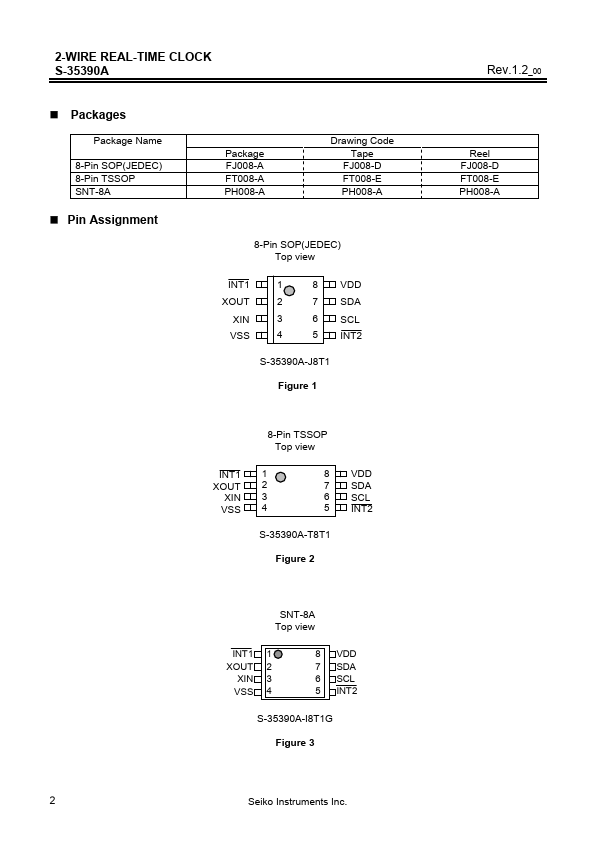
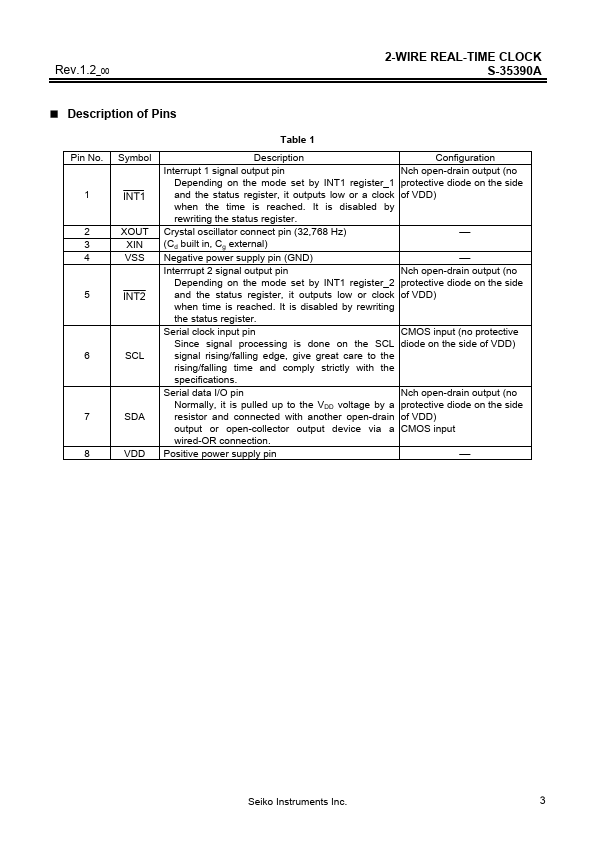
Table 1 Pin No.
Symbol Description Interrupt 1 signal output pin Depending on the mode set by INT1 register_1 and the status register, it outputs low or a clock when the time is reached.
It is disabled by rewriting the status register.
| Part number | S35390A |
|---|---|
| Manufacturer | Seiko Instruments |
| File Size | 519.86 KB |
| Description | 2-Wire Real Time Clock |
| Datasheet |
S35390A Datasheet
|
|
|
|
Note: Below is a high-fidelity text extraction (approx. 800 characters) for S35390A. For precise diagrams, and layout, please refer to the original PDF.
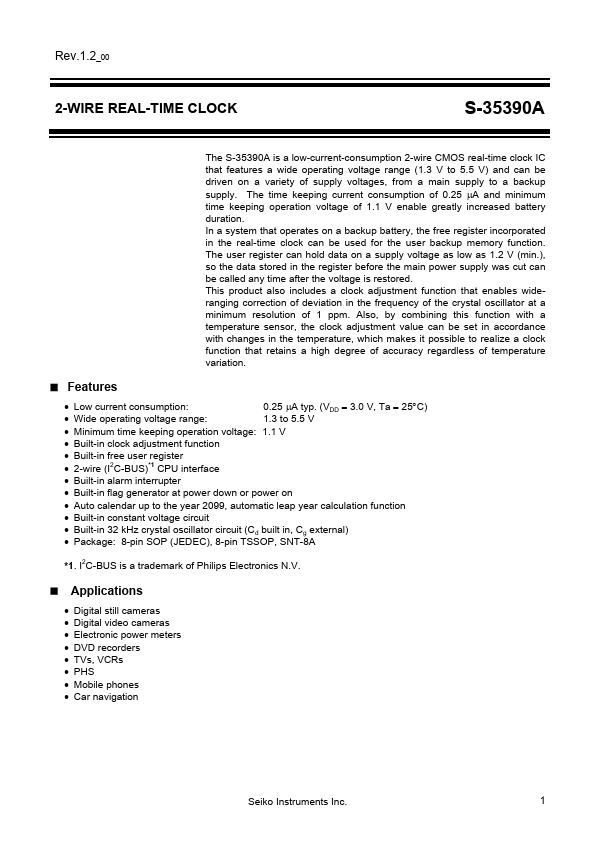
Rev.1.2_00 2-WIRE REAL-TIME CLOCK S-35390A The S-35390A is a low-current-consumption 2-wire CMOS real-time clock IC that features a wide operating voltage range (1.3 V to...
| Part Number | Description |
|---|