Download LNBK14 Datasheet PDF
STMicroelectronics
LNBK14
LNBK14 is LNB SUPPLY AND CONTROL VOLTAGE REGULATOR PARALLEL INTERFACE manufactured by STMicroelectronics.
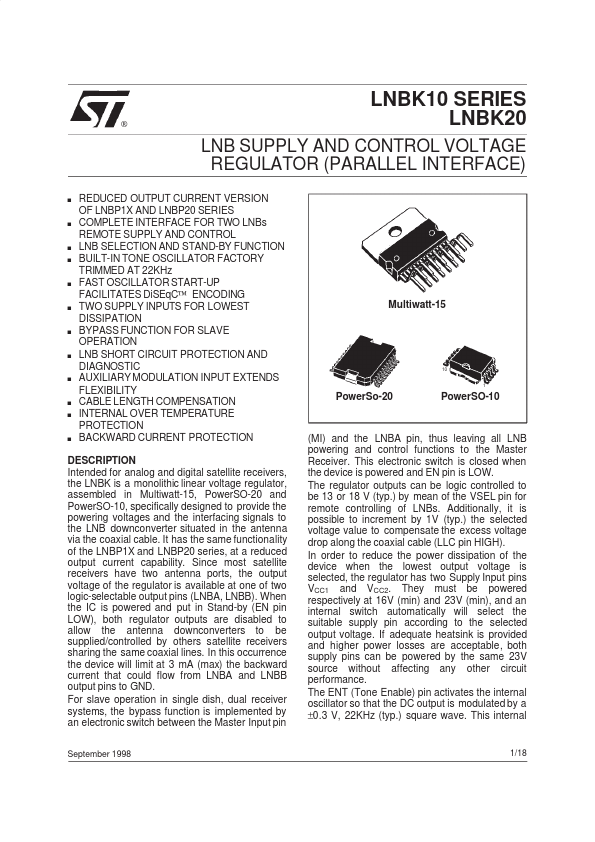
DESCRIPTION Intended for analog and digital satellite receivers, the LNBK is a monolithic linear voltage regulator, assembled in Multiwatt-15, Power SO-20 and Power SO-10, specifically designed to provide the powering voltages and the interfacing signals to the LNB downconverter situated in the antenna via the coaxial cable. It has the same functionality of the LNBP1X and LNBP20 series, at a reduced output current capability. Since most satellite receivers have two antenna ports, the output voltage of the regulator is available at one of two logic-selectable output pins (LNBA, LNBB). When the IC is powered and put in Stand-by (EN pin LOW), both regulator outputs are disabled to allow the antenna downconverters to be supplied/controlled by others satellite receivers sharing the same coaxial lines. In this occurrence the device will limit at 3 m A (max) the backward current that could flow from LNBA and LNBB output pins to GND. For slave operation in single dish, dual receiver systems, the bypass function is implemented by an electronic switch between the Master Input pin September 1998 (MI) and the LNBA pin, thus leaving all LNB powering and control functions to the Master Receiver. This electronic switch is closed when the device is powered and EN pin is LOW. The regulator outputs can be logic controlled to be 13 or 18 V (typ.) by mean of the VSEL pin for remote controlling of LNBs. Additionally, it is possible to increment by 1V (typ.) the selected voltage value to pensate the excess voltage drop along the coaxial cable (LLC pin HIGH). In order to reduce the power dissipation of the device when the lowest output voltage is selected, the regulator has two Supply Input pins VCC1 and VCC2. They must be powered respectively at 16V (min) and 23V (min), and an internal switch automatically will select the suitable supply pin according to the selected output voltage. If adequate heatsink is provided and higher power losses are acceptable, both supply pins can be powered by...