Datasheet4U Logo Datasheet4U.com

RF5611 - (RF5500 - RF5611) 11B/G WLAN SP3T Switch

Download the RF5611 datasheet PDF. This datasheet also covers the RF5500 variant, as both devices belong to the same (rf5500 - rf5611) 11b/g wlan sp3t switch family and are provided as variant models within a single manufacturer datasheet.

Features

  • Single supply voltage 3.0 V to 4.5 V.
  • Integrated SP3T switch and low noise amplifier.
  • Typical gain is 12 dB and 1.7 dB noise figure in receive mode pin-to-pin.
  • SP3T switch control voltage 2.1 to 5 V (3.0 V typical).
  • Ideal for 2.5 GHz ISM band, portable battery-powered, and WiFi/Bluetooth® combination devices For sales or technical support, contact your authorized local sales representative (see www. rfmd. com/globalsales). Register to r.

📥 Download Datasheet

Note: The manufacturer provides a single datasheet file (RF5500_RFMicroDevices.pdf) that lists specifications for multiple related part numbers.

Datasheet Details

Part number RF5611
Manufacturer RF Micro Devices
File Size 694.20 KB
Description (RF5500 - RF5611) 11B/G WLAN SP3T Switch
Datasheet download datasheet RF5611 Datasheet

Full PDF Text Transcription (Reference)

The following content is an automatically extracted verbatim text from the original manufacturer datasheet and is provided for reference purposes only.

View original datasheet text
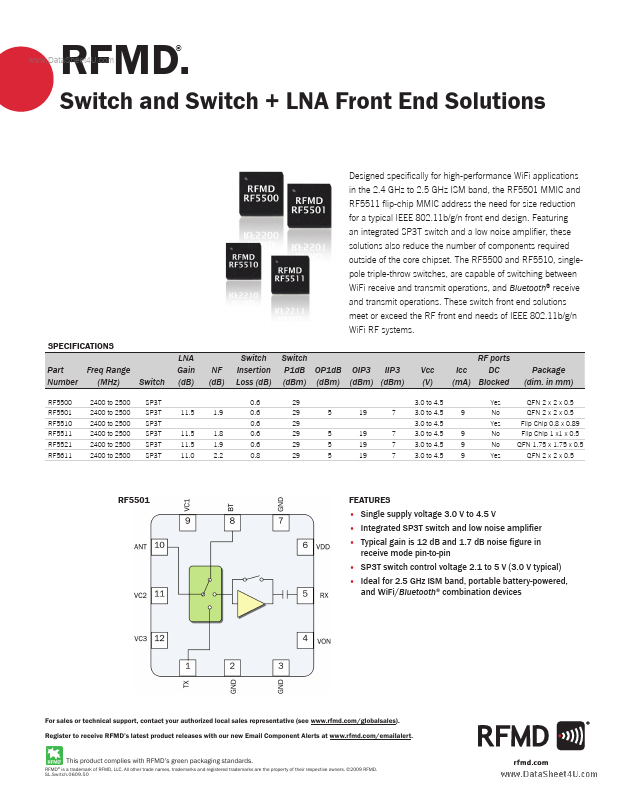
www.DataSheet4U.com RFMD. ® Switch and Switch + LNA Front End Solutions Designed specifically for high-performance WiFi applications in the 2.4 GHz to 2.5 GHz ISM band, the RF5501 MMIC and RF5511 flip-chip MMIC address the need for size reduction for a typical IEEE 802.11b/g/n front end design. Featuring an integrated SP3T switch and a low noise amplifier, these solutions also reduce the number of components required outside of the core chipset. The RF5500 and RF5510, singlepole triple-throw switches, are capable of switching between WiFi receive and transmit operations, and Bluetooth® receive and transmit operations. These switch front end solutions meet or exceed the RF front end needs of IEEE 802.11b/g/n WiFi RF systems.
Published: |