
Datasheet4U Logo Datasheet4U.com

MAC12SN - Sensitive Gate Triacs

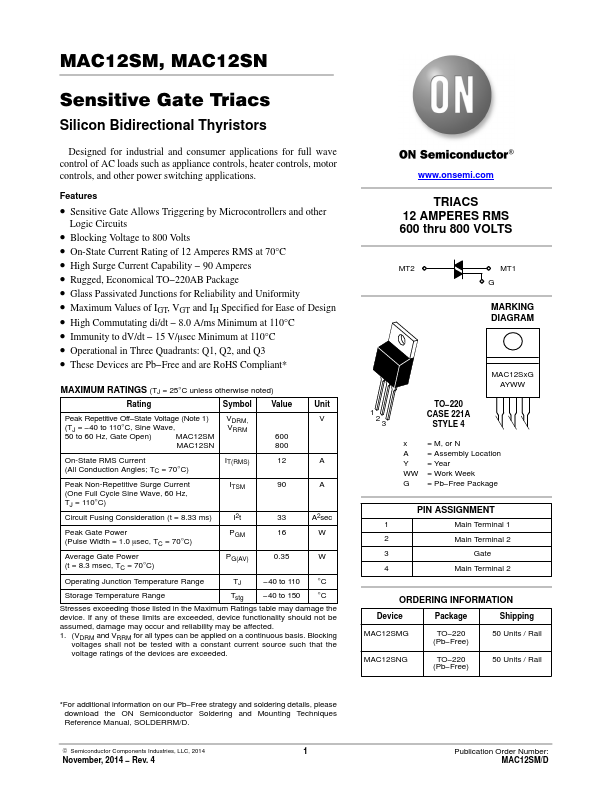
Download the MAC12SN datasheet PDF. This datasheet also covers the MAC12SM variant, as both devices belong to the same sensitive gate triacs family and are provided as variant models within a single manufacturer datasheet.

Key Features

  • Sensitive Gate Allows Triggering by Microcontrollers and other Logic Circuits.
  • Blocking Voltage to 800 Volts.
  • On-State Current Rating of 12 Amperes RMS at 70°C.
  • High Surge Current Capability.
  • 90 Amperes.
  • Rugged, Economical TO.
  • 220AB Package.
  • Glass Passivated Junctions for Reliability and Uniformity.
  • Maximum Values of IGT, VGT and IH Specified for Ease of Design.
  • High Commutating di/dt.
  • 8.0 A/ms Mini.

📥 Download Datasheet

Note: The manufacturer provides a single datasheet file (MAC12SM-ONSemiconductor.pdf) that lists specifications for multiple related part numbers.

Datasheet Details

Part number MAC12SN
Manufacturer onsemi
File Size 104.22 KB
Description Sensitive Gate Triacs
Datasheet download datasheet MAC12SN Datasheet

Full PDF Text Transcription for MAC12SN (Reference)

Note: Below is a high-fidelity text extraction (approx. 800 characters) for MAC12SN. For precise diagrams, and layout, please refer to the original PDF.

MAC12SM, MAC12SN Sensitive Gate Triacs Silicon Bidirectional Thyristors Designed for industrial and consumer applications for full wave control of AC loads such as applia...

View more extracted text
consumer applications for full wave control of AC loads such as appliance controls, heater controls, motor controls, and other power switching applications. Features • Sensitive Gate Allows Triggering by Microcontrollers and other Logic Circuits • Blocking Voltage to 800 Volts • On-State Current Rating of 12 Amperes RMS at 70°C • High Surge Current Capability − 90 Amperes • Rugged, Economical TO−220AB Package • Glass Passivated Junctions for Reliability and Uniformity • Maximum Values of IGT, VGT and IH Specified for Ease of Design • High Commutating di/dt − 8.