
Datasheet4U Logo Datasheet4U.com

ADP3211A - Synchronous Buck Controller

Download the ADP3211A datasheet PDF. This datasheet also covers the ADP3211 variant, as both devices belong to the same synchronous buck controller family and are provided as variant models within a single manufacturer datasheet.

General Description

Pin No.

Good Output.

drain output.

Key Features

  • Single.
  • Chip Solution.
  • Fully Compatible with the Intel® IMVP.
  • 6.5t CPU and GMCH Chipset Voltage Regulator Specifications Integrated MOSFET Drivers.
  • Input Voltage Range of 3.3 V to 22 V.
  • ±7 mV Worst.
  • Case Differentially Sensed Core Voltage Error Overtemperature.
  • Automatic Power.
  • Saving Modes Maximize Efficiency During Light Load Operation.
  • Soft Transient Control Reduces Inrush Current and Audio Noise.
  • Inde.

📥 Download Datasheet

Note: The manufacturer provides a single datasheet file (ADP3211_ONSemiconductor.pdf) that lists specifications for multiple related part numbers.

Datasheet Details

Part number ADP3211A
Manufacturer onsemi
File Size 586.60 KB
Description Synchronous Buck Controller
Datasheet download datasheet ADP3211A Datasheet

Full PDF Text Transcription (Reference)

The following content is an automatically extracted verbatim text from the original manufacturer datasheet and is provided for reference purposes only.

View original datasheet text
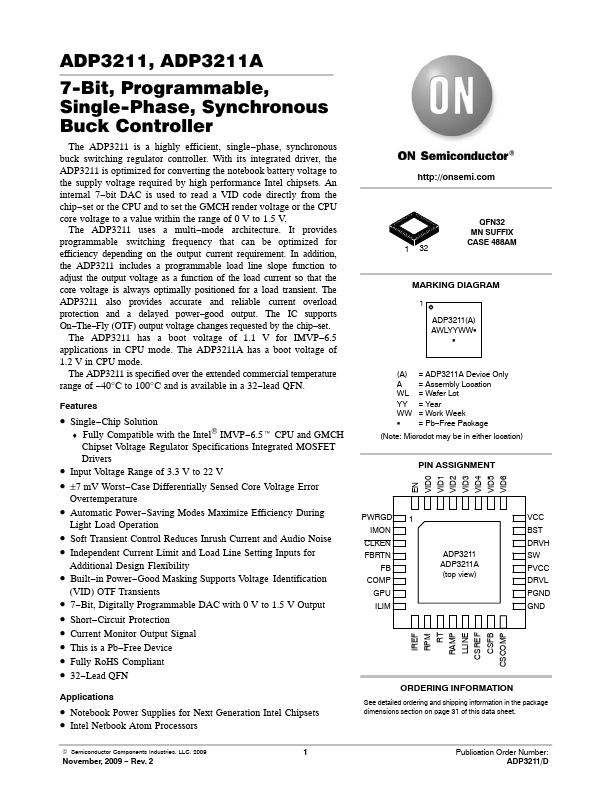
ADP3211, ADP3211A 7-Bit, Programmable, Single-Phase, Synchronous Buck Controller The ADP3211 is a highly efficient, single−phase, synchronous buck switching regulator controller. With its integrated driver, the ADP3211 is optimized for converting the notebook battery voltage to the supply voltage required by high performance Intel chipsets. An internal 7−bit DAC is used to read a VID code directly from the chip−set or the CPU and to set the GMCH render voltage or the CPU core voltage to a value within the range of 0 V to 1.5 V. The ADP3211 uses a multi−mode architecture. It provides programmable switching frequency that can be optimized for efficiency depending on the output current requirement.