
Datasheet4U Logo Datasheet4U.com

LM1112B - Dolby B-Type Noise Reduction Processor

Download the LM1112B datasheet PDF. This datasheet also covers the LM1112 variant, as both devices belong to the same dolby b-type noise reduction processor family and are provided as variant models within a single manufacturer datasheet.

General Description

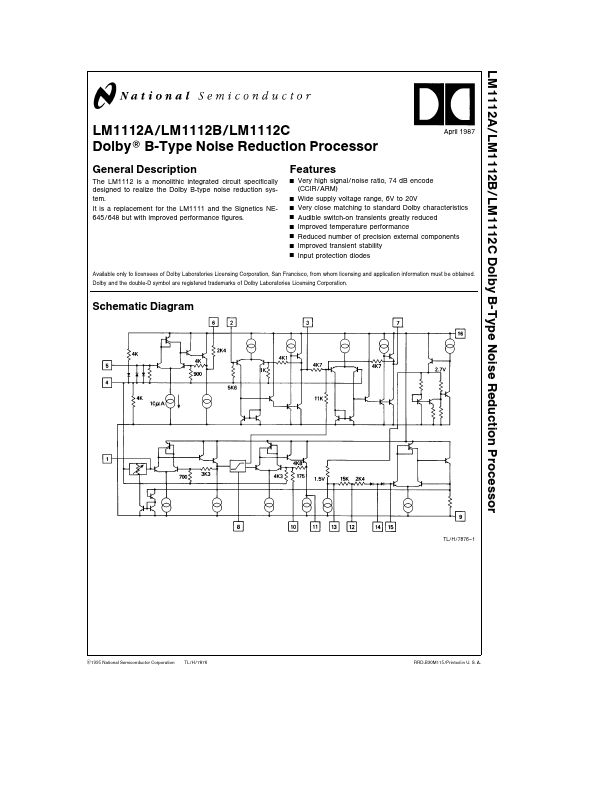
The LM1112 is a monolithic integrated circuit specifically designed to realize the Dolby B-type noise reduction system It is a replacement for the LM1111 and the Signetics NE645 648 but with improved performance figures

Key Features

  • Y Very high signal noise ratio 74 dB encode (CCIR ARM) Y Wide supply voltage range 6V to 20V Y Very close matching to standard Dolby characteristics Y Audible switch-on transients greatly reduced Y Improved temperature performance Y Reduced number of precision external components Y Improved transient stability Y Input protection diodes Available only to licensees of Dolby Laboratories Licensing Corporation San Francisco from whom licensing and.

📥 Download Datasheet

Note: The manufacturer provides a single datasheet file (LM1112_NationalSemiconductor.pdf) that lists specifications for multiple related part numbers.

Full PDF Text Transcription for LM1112B (Reference)

Note: Below is a high-fidelity text extraction (approx. 800 characters) for LM1112B. For precise diagrams, and layout, please refer to the original PDF.

LM1112A LM1112B LM1112C Dolby B-Type Noise Reduction Processor LM1112A LM1112B LM1112C Dolby B-Type Noise Reduction Processor April 1987 General Description The LM1112 is...

View more extracted text
Noise Reduction Processor April 1987 General Description The LM1112 is a monolithic integrated circuit specifically designed to realize the Dolby B-type noise reduction system It is a replacement for the LM1111 and the Signetics NE645 648 but with improved performance figures Features Y Very high signal noise ratio 74 dB encode (CCIR ARM) Y Wide supply voltage range 6V to 20V Y Very close matching to standard Dolby characteristics Y Audible switch-on transients greatly reduced Y Improved temperature performance Y Reduced number of precision external components Y Improved transient stability Y Input protection diodes Availa