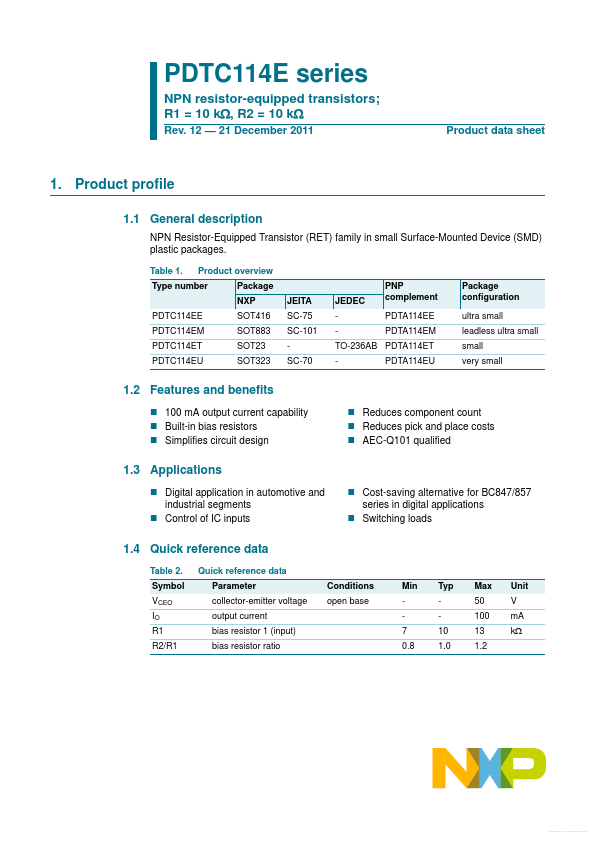

PDTC114EE
PDTC114EE is NPN resistor-equipped transistors manufactured by NXP Semiconductors.
- Part of the PDTC114E comparator family.
- Part of the PDTC114E comparator family.
FEATURES
High Efficiency, Eight-String, White LED Driver for LCD Backlight Applications ADD5201
BLOCK DIAGRAM
STEP-UP SWITCHING REGULATOR
White LED driver based on inductive boost converter Integrated 50 V MOSFET with 2.9 A peak current limit Input voltage range: 6 V to 21 V Maximum output adjustable up to 45 V 350 k Hz to 1 MHz adjustable operating frequency Built-in soft start for boost converter Drives up to eight LED current sources LED current adjustable up to 30 m A for each channel Headroom control to maximize efficiency Adjustable output dimming frequency: 200 Hz to 10 k Hz LED open/short fault protection Selectable brightness control interface modes PWM input SMBus serial interface Selectable dimming controls Fixed delay PWM dimming control with 8-bit resolution No delay PWM dimming control with 8-bit resolution Phase shift PWM dimming control with 8-bit resolution Direct PWM dimming control DC current dimming mode with 8-bit resolution General Thermal shutdown Undervoltage lockout 28-lead, 4 mm × 4 mm LFCSP
EIGHT CURRENT SOURCES
INTERFACE 8-BIT DIMMING CONTROL LOGIC
Figure 1.
APPLICATIONS
Notebook PCs, UMPCs, and monitor displays
GENERAL DESCRIPTION
The ADD5201 is a white LED driver for backlight applications based on high efficiency, current mode, step-up converter technology. It is designed with a 0.15 Ω, 2.9 A internal switch and a pin adjustable operating frequency between 350 k Hz and 1 MHz. The ADD5201 contains eight regulated current sources for uniform brightness intensity. Each current source can be driven up to 30 m A. The ADD5201 drives up to eight parallel strings of multiple series connected LEDs with a ±1.5% current regulation accuracy. The device provides an adjustable LED driving current up to 30 m A for each channel by an external resistor. The ADD5201 provides various brightness control methods. The LED dimming control can be achieved through SMBus and/or pulse-width modulation (PWM) input. Each dimming mode is selectable with two...