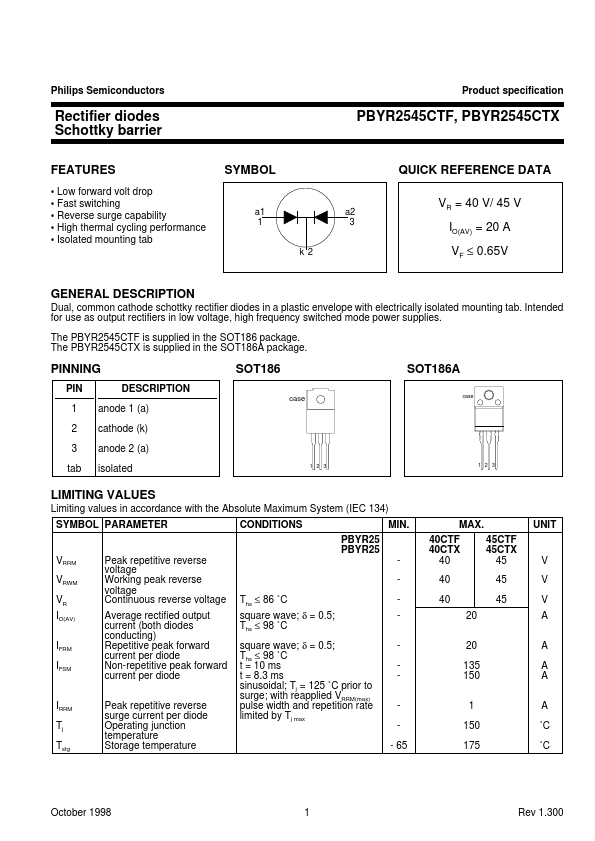

PBYR2540CTX
PBYR2540CTX is Rectifier diodes Schottky barrier manufactured by NXP Semiconductors.
FEATURES
- Low forward volt drop
- Fast switching
- Reverse surge capability
- High thermal cycling performance
- Isolated mounting tab
PBYR2545CTF, PBYR2545CTX
SYMBOL
QUICK REFERENCE DATA VR = 40 V/ 45 V IO(AV) = 20 A VF ≤ 0.65V a1 1 k 2 a2 3
GENERAL DESCRIPTION
Dual, mon cathode schottky rectifier diodes in a plastic envelope with electrically isolated mounting tab. Intended for use as output rectifiers in low voltage, high frequency switched mode power supplies. The PBYR2545CTF is supplied in the SOT186 package. The PBYR2545CTX is supplied in the SOT186A package.
PINNING
PIN 1 2 3 tab DESCRIPTION anode 1 (a) cathode (k) anode 2 (a) isolated
SOT186 case
SOT186A case
1 2 3
1 2 3
LIMITING VALUES
Limiting values in accordance with the Absolute Maximum System (IEC 134) SYMBOL PARAMETER CONDITIONS PBYR25 PBYR25 VRRM VRWM VR IO(AV) IFRM IFSM Peak repetitive reverse voltage Working peak reverse voltage Continuous reverse voltage Average rectified output current (both diodes conducting) Repetitive peak forward current per diode Non-repetitive peak forward current per diode Peak repetitive reverse surge current per diode Operating junction temperature Storage temperature Ths ≤ 86 ˚C square wave; δ = 0.5; Ths ≤ 98 ˚C square wave; δ = 0.5; Ths ≤ 98 ˚C t = 10 ms t = 8.3 ms sinusoidal; Tj = 125 ˚C prior to surge; with reapplied VRRM(max) pulse width and repetition rate limited by Tj max
- 65 MIN. MAX. 40CTF 40CTX 40 40 40 20 20 135 150 1 150 175 45CTF 45CTX 45 45 45 UNIT
V V V A A A A A ˚C ˚C
IRRM Tj Tstg
October 1998
Rev 1.300
Philips Semiconductors
Product specification
Rectifier diodes Schottky barrier
ISOLATION LIMITING VALUE & CHARACTERISTIC
Ths = 25 ˚C unless otherwise specified SYMBOL PARAMETER Visol Peak isolation voltage from all terminals to external heatsink CONDITIONS
PBYR2545CTF, PBYR2545CTX
MIN.
- TYP. MAX. UNIT 1500 V
SOT186 package; R.H. ≤ 65%; clean and dustfree
Visol
R.M.S. isolation voltage from SOT186A package; f = 50-60 Hz; all...