

Datasheet4U Logo Datasheet4U.com

P89C662 - 8-bit 80C51 5V low power 16 kB/32 kB/64 kB flash microcontroller

This page provides the datasheet information for the P89C662, a member of the P89C660 8-bit 80C51 5V low power 16 kB/32 kB/64 kB flash microcontroller family.

Datasheet Summary

Description

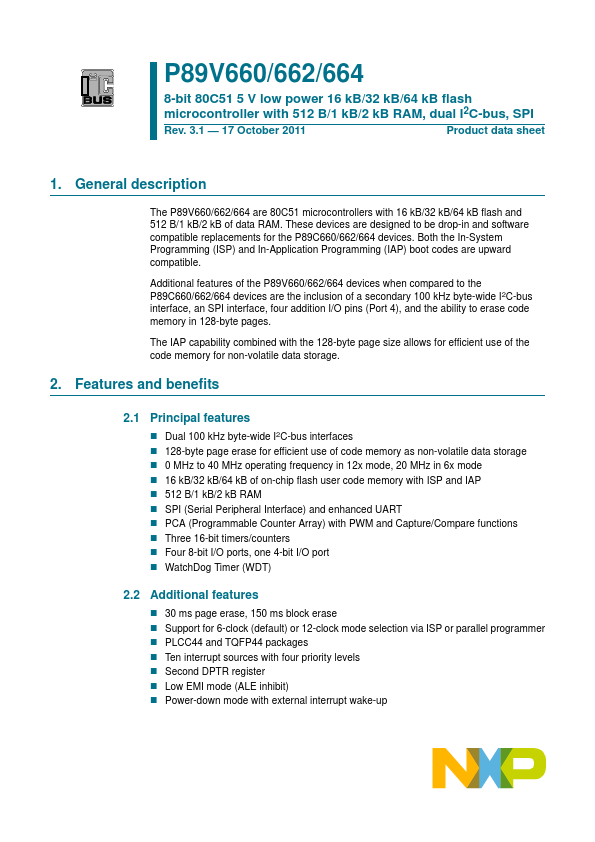
The P89V660/662/664 are 80C51 microcontrollers with 16 kB/32 kB/64 kB flash and 512 B/1 kB/2 kB of data RAM.

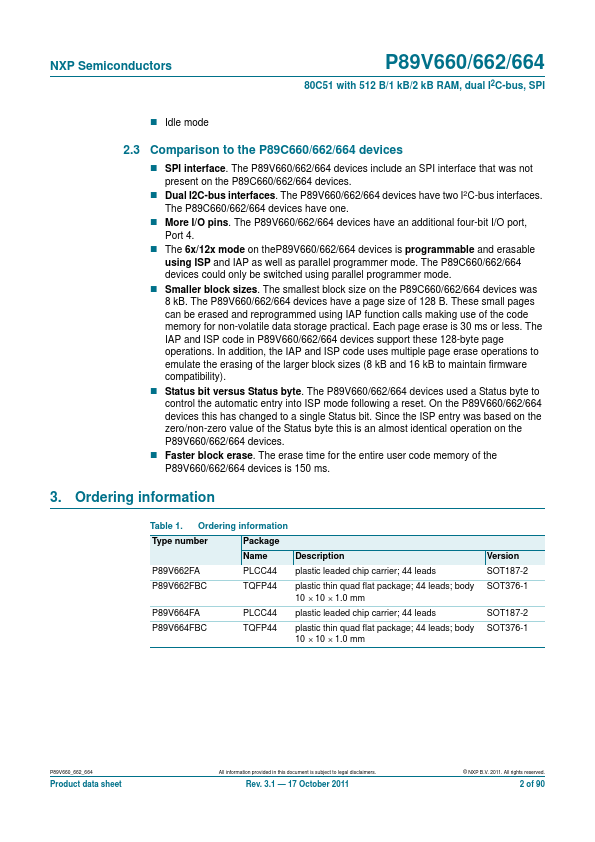
These devices are designed to be drop-in and software compatible replacements for the P89C660/662/664 devices.

Features

  • 2.1 Principal features.
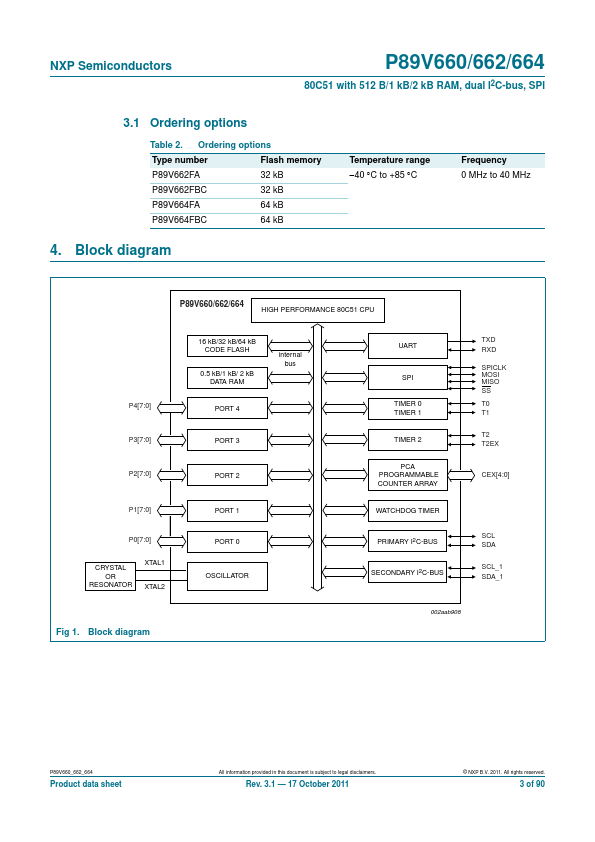
  • Dual 100 kHz byte-wide I2C-bus interfaces.
  • 128-byte page erase for efficient use of code memory as non-volatile data storage.
  • 0 MHz to 40 MHz operating frequency in 12x mode, 20 MHz in 6x mode.
  • 16 kB/32 kB/64 kB of on-chip flash user code memory with ISP and IAP.
  • 512 B/1 kB/2 kB RAM.
  • SPI (Serial Peripheral Interface) and enhanced UART.
  • PCA (Programmable Counter Array) with PWM and Capture/Compare functions.
  • Three 16-bit timers/count.

📥 Download Datasheet

Datasheet preview – P89C662

Datasheet Details

Part number P89C662
Manufacturer NXP
File Size 681.53 KB
Description 8-bit 80C51 5V low power 16 kB/32 kB/64 kB flash microcontroller
Datasheet download datasheet P89C662 Datasheet
Additional preview pages of the P89C662 datasheet.
Other Datasheets by NXP

Full PDF Text Transcription

Click to expand full text
P89V660/662/664 8-bit 80C51 5 V low power 16 kB/32 kB/64 kB flash microcontroller with 512 B/1 kB/2 kB RAM, dual I2C-bus, SPI Rev. 3.1 — 17 October 2011 Product data sheet 1. General description The P89V660/662/664 are 80C51 microcontrollers with 16 kB/32 kB/64 kB flash and 512 B/1 kB/2 kB of data RAM. These devices are designed to be drop-in and software compatible replacements for the P89C660/662/664 devices. Both the In-System Programming (ISP) and In-Application Programming (IAP) boot codes are upward compatible. Additional features of the P89V660/662/664 devices when compared to the P89C660/662/664 devices are the inclusion of a secondary 100 kHz byte-wide I2C-bus interface, an SPI interface, four addition I/O pins (Port 4), and the ability to erase code memory in 128-byte pages.
Published: |