RE46C152
RE46C152 is CMOS Ionization Smoke Detector ASIC manufactured by Microchip Technology.
Description
The RE46C152 is a low power CMOS ionization type smoke detector IC. With few external ponents this circuit will provide all the required features for an ionization type smoke detector. An internal oscillator strobes power to the smoke detection circuitry for 10.5m S every 1.66 seconds to keep standby current to a minimum. A check for a low battery condition is performed every 40 seconds when in standby. The Tone input allows for selection of a temporal pattern or a 2/3 duty cycle continuous tone. The temporal horn pattern supports the NFPA 72 emergency evacuation signal. An interconnect pin allows multiple detectors to be connected such that when one units alarms all units will sound. An internal 8 minute timer allows for a separate button to be used for reduced sensitivity mode. Single button operation for test and timer mode is also possible. Although this device was designed for smoke detection utilizing an ionization chamber it could be used in a variety of security applications. Utilizing low power CMOS technology the RE46C152 was designed for use in smoke detectors that ply with Underwriters Laboratory Specification UL217 and UL268.
Features
- -
- -
- -
- -
- -
- - >1500V ESD Protection (HBM) on all Pins Guard Outputs for Ion Detector Input +/-0.75p A Detect Input Current Internal Reverse Battery Protection Low Quiescent Current Consumption (<6.5u A) 16L PDIP Internal Low Battery Detection Power Up Low Battery Test Interconnect up to 40 Detectors Pin selectable horn patterns 8 Minute Timer for Sensitivity Control
Available in Ro HS pliant Pb Free Packaging.
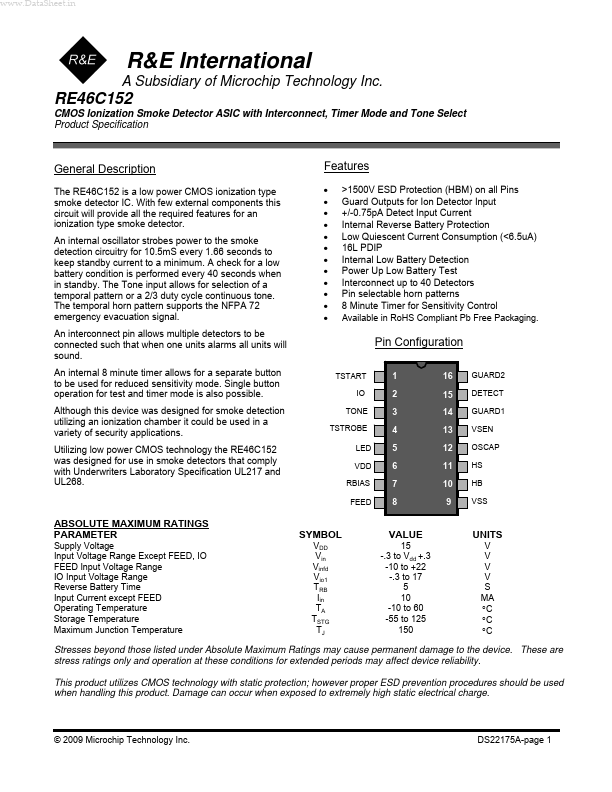
Pin Configuration
TSTART IO TONE TSTROBE LED VDD RBIAS FEED
1 2 3 4 5 6 7 8
16 15 14 13 12 11 10 9
GUARD2 DETECT GUARD1 VSEN OSCAP HS HB VSS
ABSOLUTE MAXIMUM RATINGS PARAMETER
Supply Voltage Input Voltage Range Except FEED, IO FEED Input Voltage Range IO Input Voltage Range Reverse Battery Time Input Current except FEED Operating Temperature Storage Temperature Maximum Junction...