
Datasheet4U Logo Datasheet4U.com

PIC16LF1778 - 8-Bit Flash Microcontroller

Download the PIC16LF1778 datasheet PDF. This datasheet also covers the PIC16F1777 variant, as both devices belong to the same 8-bit flash microcontroller family and are provided as variant models within a single manufacturer datasheet.

Description

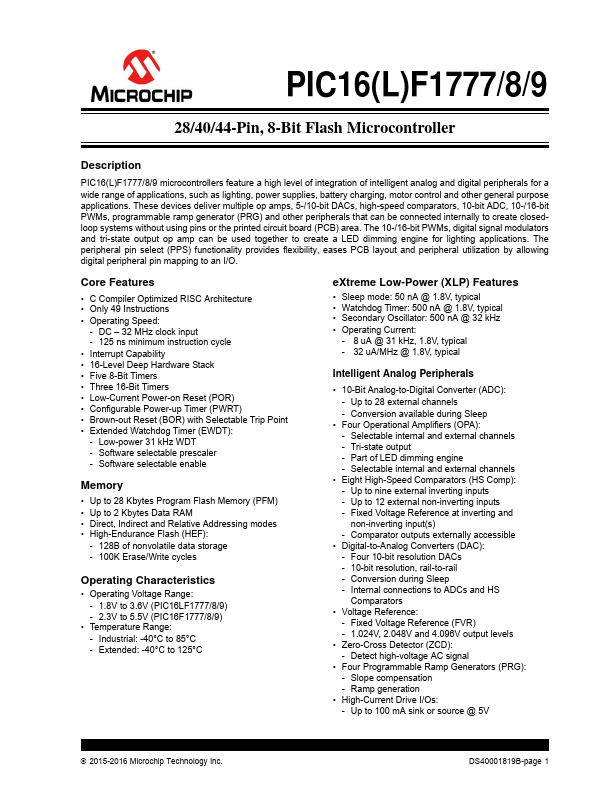
PIC16(L)F1777/8/9 microcontrollers feature a high level of integration of intelligent analog and digital peripherals for a wide range of applications, such as lighting, power supplies, battery charging, motor control and other general purpose applications.

Features

  • C Compiler Optimized RISC Architecture.
  • Only 49 Instructions.
  • Operating Speed: - DC.
  • 32 MHz clock input - 125 ns minimum instruction cycle.
  • Interrupt Capability.
  • 16-Level Deep Hardware Stack.
  • Five 8-Bit Timers.
  • Three 16-Bit Timers.
  • Low-Current Power-on Reset (POR).
  • Configurable Power-up Timer (PWRT).
  • Brown-out Reset (BOR) with Selectable Trip Point.
  • Extended Watchdog Timer (EWDT): - Low-p.

📥 Download Datasheet

Note: The manufacturer provides a single datasheet file (PIC16F1777-Microchip.pdf) that lists specifications for multiple related part numbers.

Full PDF Text Transcription (Reference)

The following content is an automatically extracted verbatim text from the original manufacturer datasheet and is provided for reference purposes only.

View original datasheet text
PIC16(L)F1777/8/9 28/40/44-Pin, 8-Bit Flash Microcontroller Description PIC16(L)F1777/8/9 microcontrollers feature a high level of integration of intelligent analog and digital peripherals for a wide range of applications, such as lighting, power supplies, battery charging, motor control and other general purpose applications. These devices deliver multiple op amps, 5-/10-bit DACs, high-speed comparators, 10-bit ADC, 10-/16-bit PWMs, programmable ramp generator (PRG) and other peripherals that can be connected internally to create closedloop systems without using pins or the printed circuit board (PCB) area. The 10-/16-bit PWMs, digital signal modulators and tri-state output op amp can be used together to create a LED dimming engine for lighting applications.
Published: |