Datasheet4U Logo Datasheet4U.com

DSA612 - Two-Output Low Power MEMS Clock Generator

General Description

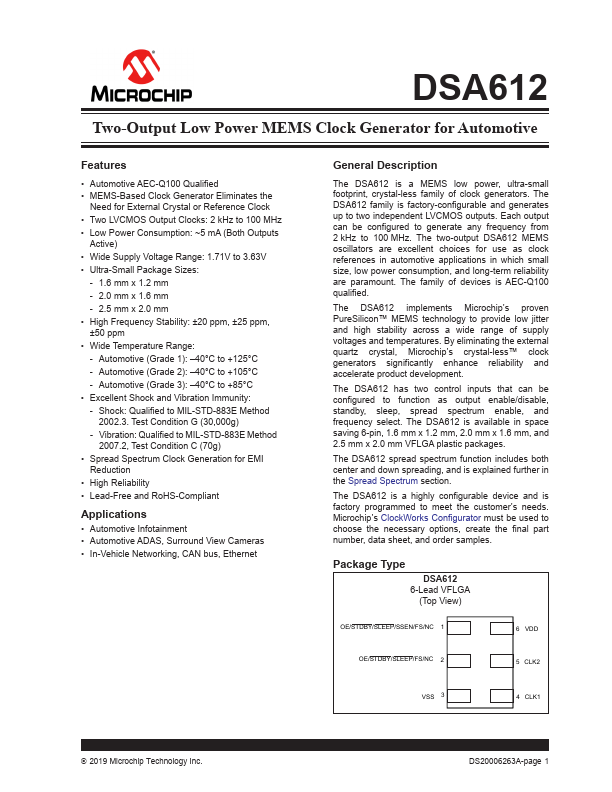
The DSA612 is a MEMS low power, ultra-small footprint, crystal-less family of clock generators.

The DSA612 family is factory-configurable and generates up to two independent LVCMOS outputs.

Each output can be configured to generate any frequency from 2 kHz to 100 MHz.

Key Features

  • Automotive AEC-Q100 Qualified.
  • MEMS-Based Clock Generator Eliminates the Need for External Crystal or Reference Clock.
  • Two LVCMOS Output Clocks: 2 kHz to 100 MHz.
  • Low Power Consumption: ~5 mA (Both Outputs Active).
  • Wide Supply Voltage Range: 1.71V to 3.63V.
  • Ultra-Small Package Sizes: - 1.6 mm x 1.2 mm - 2.0 mm x 1.6 mm - 2.5 mm x 2.0 mm.
  • High Frequency Stability: ±20 ppm, ±25 ppm, ±50 ppm.
  • Wide Temperature Range: - Automoti.

📥 Download Datasheet

Datasheet Details

Part number DSA612
Manufacturer Microchip
File Size 1.38 MB
Description Two-Output Low Power MEMS Clock Generator
Datasheet download datasheet DSA612 Datasheet

Full PDF Text Transcription (Reference)

The following content is an automatically extracted verbatim text from the original manufacturer datasheet and is provided for reference purposes only.

View original datasheet text
DSA612 Two-Output Low Power MEMS Clock Generator for Automotive Features • Automotive AEC-Q100 Qualified • MEMS-Based Clock Generator Eliminates the Need for External Crystal or Reference Clock • Two LVCMOS Output Clocks: 2 kHz to 100 MHz • Low Power Consumption: ~5 mA (Both Outputs Active) • Wide Supply Voltage Range: 1.71V to 3.63V • Ultra-Small Package Sizes: - 1.6 mm x 1.2 mm - 2.0 mm x 1.6 mm - 2.5 mm x 2.0 mm • High Frequency Stability: ±20 ppm, ±25 ppm, ±50 ppm • Wide Temperature Range: - Automotive (Grade 1): –40°C to +125°C - Automotive (Grade 2): –40°C to +105°C - Automotive (Grade 3): –40°C to +85°C • Excellent Shock and Vibration Immunity: - Shock: Qualified to MIL-STD-883E Method 2002.3. Test Condition G (30,000g) - Vibration: Qualified to MIL-STD-883E Method 2007.