

Datasheet4U Logo Datasheet4U.com

MAQ4124 - Automotive AEC-Q100 Qualified Dual 3A Peak Low-Side MOSFET Driver

This page provides the datasheet information for the MAQ4124, a member of the MAQ4123 Automotive AEC-Q100 Qualified Dual 3A Peak Low-Side MOSFET Driver family.

Datasheet Summary

Description

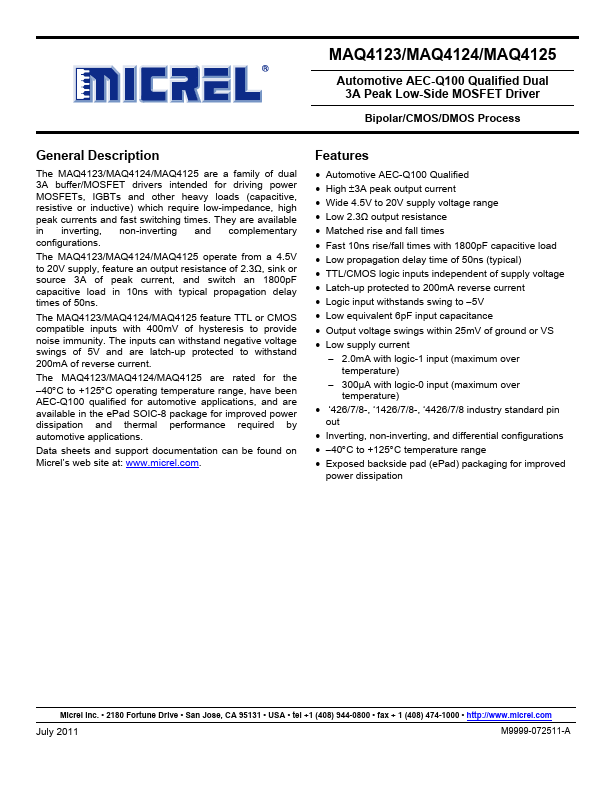
The MAQ4123/MAQ4124/MAQ4125 are a family of dual 3A buffer/MOSFET drivers intended for driving power MOSFETs, IGBTs and other heavy loads (capacitive, resistive or inductive) which require low-impedance, high peak currents and fast switching times.

Features

  • Automotive AEC-Q100 Qualified.
  • High ±3A peak output current.
  • Wide 4.5V to 20V supply voltage range.
  • Low 2.3Ω output resistance.
  • Matched rise and fall times.
  • Fast 10ns rise/fall times with 1800pF capacitive load.
  • Low propagation delay time of 50ns (typical).
  • TTL/CMOS logic inputs independent of supply voltage.
  • Latch-up protected to 200mA reverse current.
  • Logic input withstands swing to.
  • 5V.

📥 Download Datasheet

Datasheet preview – MAQ4124

Datasheet Details

Part number MAQ4124
Manufacturer Micrel Semiconductor
File Size 431.47 KB
Description Automotive AEC-Q100 Qualified Dual 3A Peak Low-Side MOSFET Driver
Datasheet download datasheet MAQ4124 Datasheet
Additional preview pages of the MAQ4124 datasheet.
Other Datasheets by Micrel Semiconductor

Full PDF Text Transcription

Click to expand full text
MAQ4123/MAQ4124/MAQ4125 Automotive AEC-Q100 Qualified Dual 3A Peak Low-Side MOSFET Driver Bipolar/CMOS/DMOS Process General Description The MAQ4123/MAQ4124/MAQ4125 are a family of dual 3A buffer/MOSFET drivers intended for driving power MOSFETs, IGBTs and other heavy loads (capacitive, resistive or inductive) which require low-impedance, high peak currents and fast switching times. They are available in inverting, non-inverting and complementary configurations. The MAQ4123/MAQ4124/MAQ4125 operate from a 4.5V to 20V supply, feature an output resistance of 2.3Ω, sink or source 3A of peak current, and switch an 1800pF capacitive load in 10ns with typical propagation delay times of 50ns.
Published: |