

MAX6972
MAX6972 is 16-Output PWM LED Drivers manufactured by Maxim Integrated.
Features
- 16 LED Current Sink Outputs (Two Banks of Eight Outputs)
- 32 LED Drive Option When Multiplexing
- 33MHz Clock Supports Up to 63 Frames per Second of Video
- Constant Output Current Calibration from 11m A to 55m A in 256 Steps
- EZCascade™ Interface Simplifies Multiple Driver Cascading Without External Buffers
- 12-Bit or 14-Bit Individual PWM LED Intensity Controls
- 7-Bit or 5-Bit Panel PWM-Intensity Control
- +3V to +7V LED Power Supply
- +3.0V to +3.6V Logic Supply
- Open-Circuit LED Fault Detection
- Optional Watchdog Timer Blanks Display if Interface Fails
- Standard -40°C to +125°C Operating Temperature Range
General Description
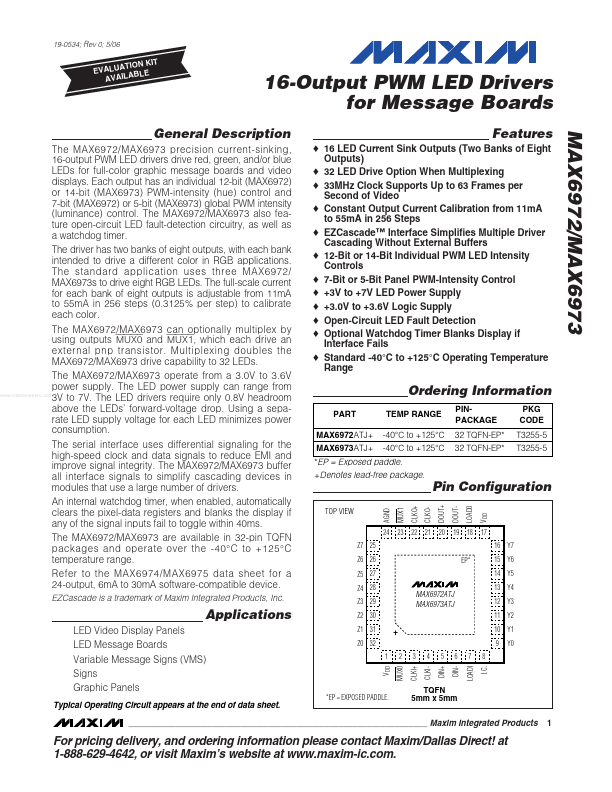
The MAX6972/MAX6973 precision current-sinking, 16-output PWM LED drivers drive red, green, and/or blue LEDs for full-color graphic message boards and video displays. Each output has an individual 12-bit (MAX6972) or 14-bit (MAX6973) PWM-intensity (hue) control and 7-bit (MAX6972) or 5-bit (MAX6973) global PWM intensity (luminance) control. The MAX6972/MAX6973 also feature open-circuit LED fault-detection circuitry, as well as a watchdog timer. The driver has two banks of eight outputs, with each bank intended to drive a different color in RGB applications. The standard application uses three MAX6972/ MAX6973s to drive eight RGB LEDs. The full-scale current for each bank of eight outputs is adjustable from 11m A to 55m A in 256 steps (0.3125% per step) to calibrate each color. The MAX6972/MAX6973 can optionally multiplex by using outputs MUX0 and MUX1, which each drive an external pnp transistor. Multiplexing doubles the MAX6972/MAX6973 drive capability to 32 LEDs. The MAX6972/MAX6973 operate from a 3.0V to 3.6V power supply. The LED power supply can range from .. 3V to 7V. The LED drivers require only 0.8V headroom above the LEDs’ forward-voltage drop. Using a separate LED supply voltage for each LED minimizes power consumption. The serial interface uses differential signaling for the high-speed clock and data signals to...