

Datasheet4U Logo Datasheet4U.com

MAX6496 - Overvoltage-Protection Switches/Limiter Controllers

Download the MAX6496 datasheet PDF. This datasheet also covers the MAX6495 variant, as both devices belong to the same overvoltage-protection switches/limiter controllers family and are provided as variant models within a single manufacturer datasheet.

General Description

The MAX6495

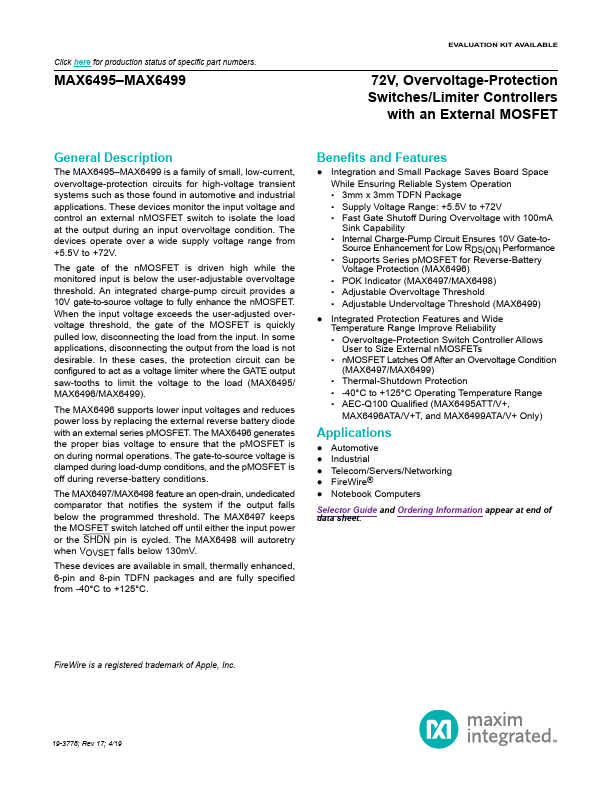
MAX6499 is a family of small, low-current, overvoltage-protection circuits for high-voltage transient systems such as those found in automotive and industrial applications.

Key Features

  • Integration and Small Package Saves Board Space While Ensuring Reliable System Operation.
  • 3mm x 3mm TDFN Package.
  • Supply Voltage Range: +5.5V to +72V.
  • Fast Gate Shutoff During Overvoltage with 100mA Sink Capability.
  • Internal Charge-Pump Circuit Ensures 10V Gate-toSource Enhancement for Low RDS(ON) Performance.
  • Supports Series pMOSFET for Reverse-Battery Voltage Protection (MAX6496).
  • POK Indicator (MAX6497/MAX6498).

📥 Download Datasheet

Note: The manufacturer provides a single datasheet file (MAX6495_MaximIntegratedProducts.pdf) that lists specifications for multiple related part numbers.

Full PDF Text Transcription (Reference)

The following content is an automatically extracted verbatim text from the original manufacturer datasheet and is provided for reference purposes only.

View original datasheet text
Click here for production status of specific part numbers. MAX6495–MAX6499 EVALUATION KIT AVAILABLE 72V, Overvoltage-Protection Switches/Limiter Controllers with an External MOSFET General Description The MAX6495–MAX6499 is a family of small, low-current, overvoltage-protection circuits for high-voltage transient systems such as those found in automotive and industrial applications. These devices monitor the input voltage and control an external nMOSFET switch to isolate the load at the output during an input overvoltage condition. The devices operate over a wide supply voltage range from +5.5V to +72V. The gate of the nMOSFET is driven high while the monitored input is below the user-adjustable overvoltage threshold.