
Datasheet Details
| Part number | MAX16806 |
|---|---|
| Manufacturer | Maxim Integrated (Analog Devices) |
| File Size | 448.59 KB |
| Description | EEPROM-Programmable |
| Datasheet |
 MAX16806 Datasheet MAX16806 Datasheet
|
|
|

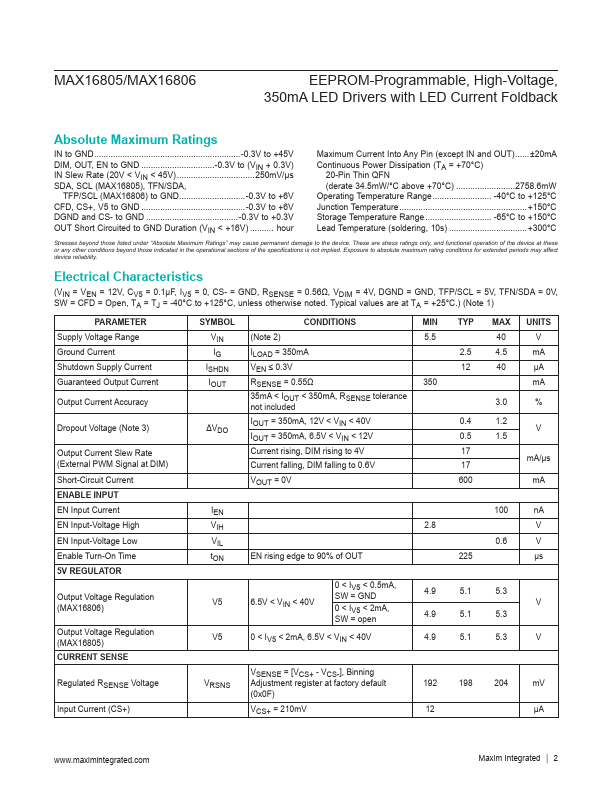
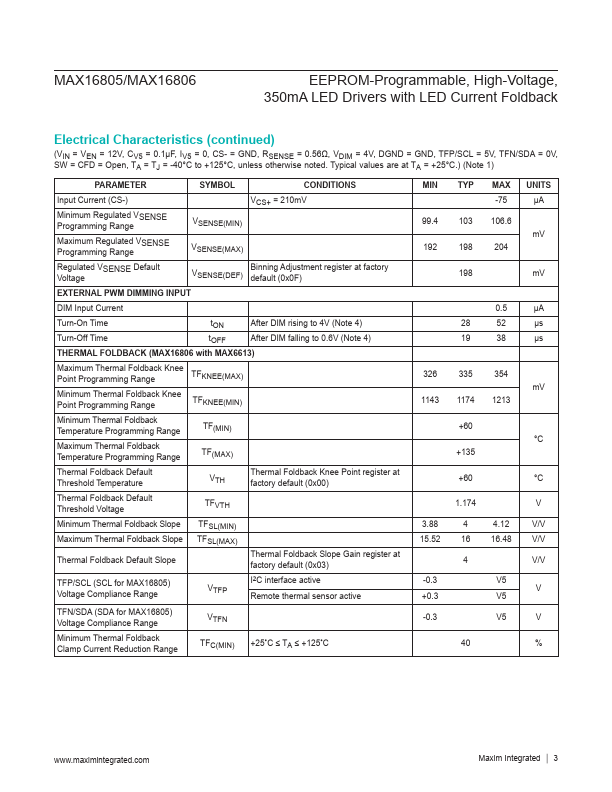
Download the MAX16806 datasheet PDF. This datasheet also covers the MAX16805 variant, as both devices belong to the same eeprom-programmable family and are provided as variant models within a single manufacturer datasheet.
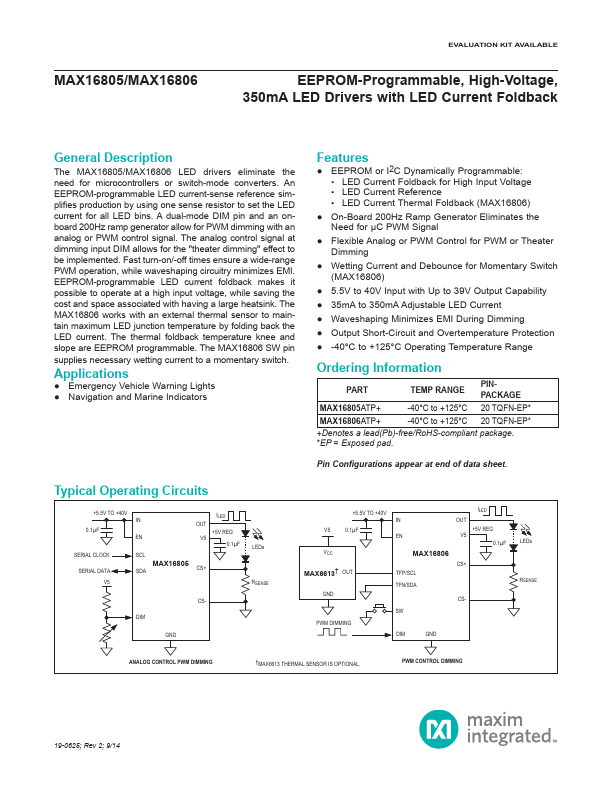
The MAX16805/MAX16806 LED drivers eliminate the need for microcontrollers or switch-mode converters for automotive interior dome, map, and courtesy light applications.
| Part number | MAX16806 |
|---|---|
| Manufacturer | Maxim Integrated (Analog Devices) |
| File Size | 448.59 KB |
| Description | EEPROM-Programmable |
| Datasheet |
MAX16806 Datasheet
|
|
|
|
| Part Number | Description | Manufacturer |
|---|---|---|
| MAX1680 | Switched-Capacitor Voltage Converters | Maxim |
| MAX1681 | Switched-Capacitor Voltage Converters | Maxim |
| MAX16813 | High-Brightness LED Driver | Maxim Integrated |
| MAX1682 | Switched-Capacitor Voltage Doublers | Maxim |
| MAX16822A | High-Brightness LED Drivers | Maxim Integrated |
| Part Number | Description |
|---|---|
| MAX16800 | Adjustable Linear High-Brightness LED (HB LED) Driver |
| MAX16801A | Offline and DC-DC PWM Controllers |
| MAX16801B | Offline and DC-DC PWM Controllers |
| MAX16802A | Offline and DC-DC PWM Controllers |
| MAX16802B | Offline and DC-DC PWM Controllers |
The following content is an automatically extracted verbatim text from the original manufacturer datasheet and is provided for reference purposes only.