
Datasheet4U Logo Datasheet4U.com

MAX1124 - 250Msps Analog-to-Digital Converter

Datasheet Summary

Description

The MAX1124 is a monolithic 10-bit, 250Msps analogto-digital converter (ADC) optimized for outstanding dynamic performance at high IF frequencies up to 500MHz.

The product operates with conversion rates of up to 250Msps while consuming only 477mW.

Features

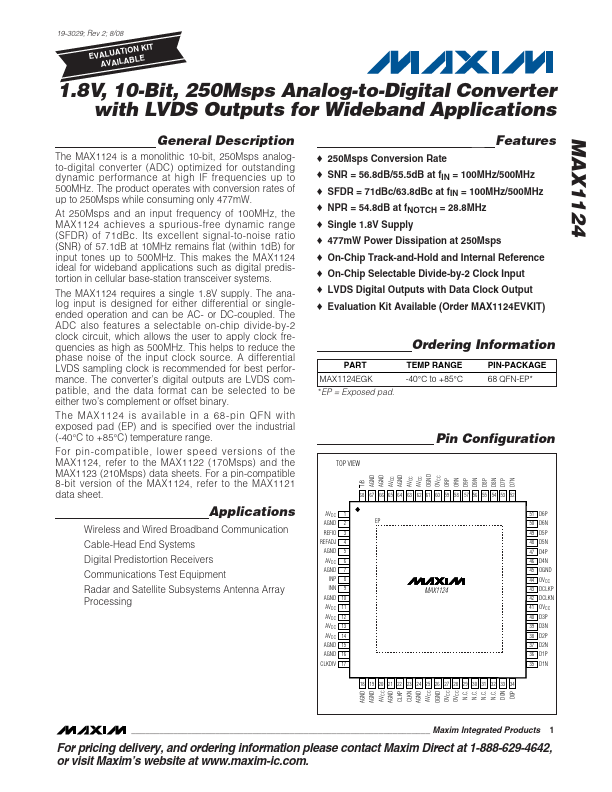
  • a selectable on-chip divide-by-2 clock circuit, which allows the user to apply clock frequencies as high as 500MHz. This helps to reduce the phase noise of the input clock source. A differential LVDS sampling clock is recommended for best performance. The converter’s digital outputs are LVDS compatible, and the data format can be selected to be either two’s complement or offset binary. The MAX1124 is available in a 68-pin QFN with exposed paddle (EP) and is specified over the industrial (-40°C t.

📥 Download Datasheet

Datasheet preview – MAX1124

Datasheet Details

Part number MAX1124
Manufacturer Maxim Integrated Products
File Size 230.18 KB
Description 250Msps Analog-to-Digital Converter
Datasheet download datasheet MAX1124 Datasheet
Additional preview pages of the MAX1124 datasheet.
Other Datasheets by Maxim Integrated Products

Full PDF Text Transcription

Click to expand full text
19-3029; Rev 1; 2/04 www.DataSheet4U.com 1.8V, 10-Bit, 250Msps Analog-to-Digital Converter with LVDS Outputs for Wideband Applications General Description The MAX1124 is a monolithic 10-bit, 250Msps analogto-digital converter (ADC) optimized for outstanding dynamic performance at high IF frequencies up to 500MHz. The product operates with conversion rates of up to 250Msps while consuming only 477mW. At 250Msps and an input frequency of 100MHz, the MAX1124 achieves a spurious-free dynamic range (SFDR) of 71dBc. Its excellent signal-to-noise ratio (SNR) of 57.1dB at 10MHz remains flat (within 1dB) for input tones up to 500MHz. This makes the MAX1124 ideal for wideband applications such as digital predistortion in cellular base-station transceiver systems. The MAX1124 requires a single 1.
Published: |