
MAX3272A
MAX3272A is +3.3V / 2.5Gbps Low-Power Limiting Amplifier manufactured by Maxim Integrated.
- Part of the MAX3272 comparator family.
- Part of the MAX3272 comparator family.
Description
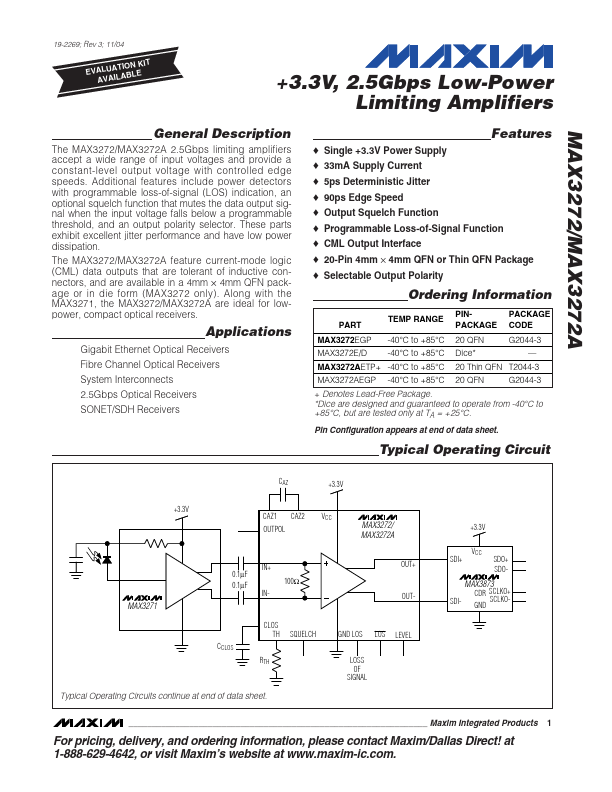
The MAX3272/MAX3272A 2.5Gbps limiting amplifiers accept a wide range of input voltages and provide a constant-level output voltage with controlled edge speeds. Additional features include power detectors with programmable loss-of-signal (LOS) indication, an optional squelch function that mutes the data output signal when the input voltage falls below a programmable threshold, and an output polarity selector. These parts exhibit excellent jitter performance and have low power dissipation.
The MAX3272/MAX3272A feature current-mode logic (CML) data outputs that are tolerant of inductive connectors, and are available in a 4mm ✕ 4mm QFN package or in die form (MAX3272 only). Along with the MAX3271, the MAX3272/MAX3272A are ideal for lowpower, pact optical receivers.
Applications
Gigabit Ethernet Optical Receivers
Fibre Channel Optical Receivers
System...