
Datasheet4U Logo Datasheet4U.com

MAX17552A - Synchronous Step-Down DC-DC Converter

Download the MAX17552A datasheet PDF. This datasheet also covers the MAX17552 variant, as both devices belong to the same synchronous step-down dc-dc converter family and are provided as variant models within a single manufacturer datasheet.

General Description

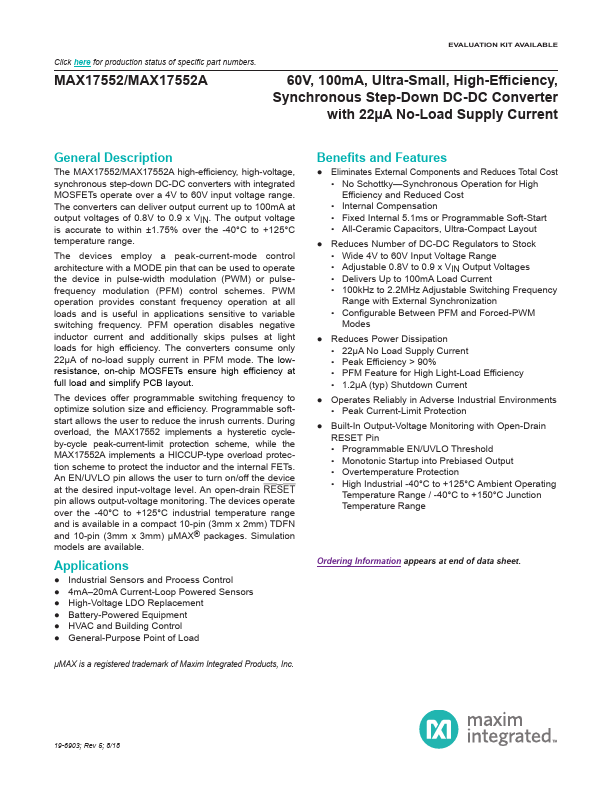
The MAX17552/MAX17552A high-efficiency, high-voltage, synchronous step-down DC-DC converters with integrated MOSFETs operate over a 4V to 60V input voltage range.

The converters can deliver output current up to 100mA at output voltages of 0.8V to 0.9 x VIN.

Key Features

  • Eliminates External Components and Reduces Total Cost.
  • No Schottky.
  • Synchronous Operation for High Efficiency and Reduced Cost.
  • Internal Compensation.
  • Fixed Internal 5.1ms or Programmable Soft-Start.
  • All-Ceramic Capacitors, Ultra-Compact Layout.
  • Reduces Number of DC-DC Regulators to Stock.
  • Wide 4V to 60V Input Voltage Range.
  • Adjustable 0.8V to 0.9 x VIN Output Voltages.
  • Delivers Up to 100mA Load Current.

📥 Download Datasheet

Note: The manufacturer provides a single datasheet file (MAX17552-Maxim.pdf) that lists specifications for multiple related part numbers.

Full PDF Text Transcription (Reference)

The following content is an automatically extracted verbatim text from the original manufacturer datasheet and is provided for reference purposes only.

View original datasheet text
Click here for production status of specific part numbers. MAX17552/MAX17552A EVALUATION KIT AVAILABLE 60V, 100mA, Ultra-Small, High-Efficiency, Synchronous Step-Down DC-DC Converter with 22µA No-Load Supply Current General Description The MAX17552/MAX17552A high-efficiency, high-voltage, synchronous step-down DC-DC converters with integrated MOSFETs operate over a 4V to 60V input voltage range. The converters can deliver output current up to 100mA at output voltages of 0.8V to 0.9 x VIN. The output voltage is accurate to within ±1.75% over the -40°C to +125°C temperature range. The devices employ a peak-current-mode control architecture with a MODE pin that can be used to operate the device in pulse-width modulation (PWM) or pulsefrequency modulation (PFM) control schemes.