Datasheet4U Logo Datasheet4U.com

MAX3054 - Fault-Protected/Tolerant CAN Transceiver

Download the MAX3054 datasheet PDF. This datasheet also covers the MAX variant, as both devices belong to the same fault-protected/tolerant can transceiver family and are provided as variant models within a single manufacturer datasheet.

General Description

The MAX3054/MAX3055/MAX3056 are interfaces between the protocol controller and the physical wires of the bus lines in a controller area network (CAN).

The devices provide differential transmit capability and switch to single-mode if certain fault conditions occur.

Key Features

  • ±80V Fault Protection.
  • Low RFI/Excellent EMC Immunity.
  • Full Wake-Up Capability During Failure Modes.
  • Bus Failure Management.
  • Support Single-Wire Transmission Mode with Ground Offset Voltages Up to 1.5V.
  • Thermally Protected.
  • Do Not Disturb the Bus Line when Unpowered.
  • Low-Current Sleep and Standby Mode with Wake-Up Through Bus Lines.
  • Up to 250kbps Data Rate (MAX3054).
  • Pin and Functionally Compatib.

📥 Download Datasheet

Note: The manufacturer provides a single datasheet file (MAX-3054.pdf) that lists specifications for multiple related part numbers.

Full PDF Text Transcription (Reference)

The following content is an automatically extracted verbatim text from the original manufacturer datasheet and is provided for reference purposes only.

View original datasheet text
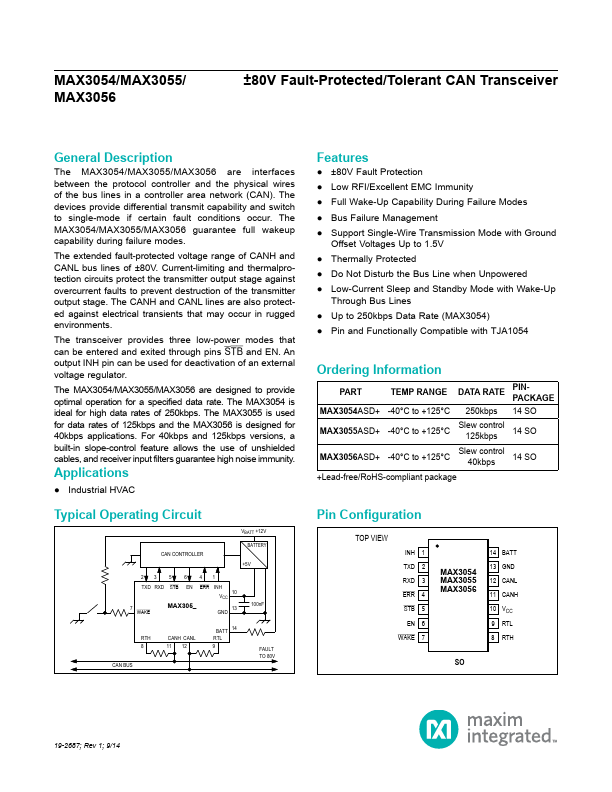
MAX3054/MAX3055/ MAX3056 ±80V Fault-Protected/Tolerant CAN Transceiver General Description The MAX3054/MAX3055/MAX3056 are interfaces between the protocol controller and the physical wires of the bus lines in a controller area network (CAN). The devices provide differential transmit capability and switch to single-mode if certain fault conditions occur. The MAX3054/MAX3055/MAX3056 guarantee full wakeup capability during failure modes. The extended fault-protected voltage range of CANH and CANL bus lines of ±80V. Current-limiting and thermalprotection circuits protect the transmitter output stage against overcurrent faults to prevent destruction of the transmitter output stage. The CANH and CANL lines are also protected against electrical transients that may occur in rugged environments.