

Datasheet4U Logo Datasheet4U.com

MA702GQ - Contactless Angle Sensor

Download the MA702GQ datasheet PDF. This datasheet also covers the MA702 variant, as both devices belong to the same contactless angle sensor family and are provided as variant models within a single manufacturer datasheet.

Description

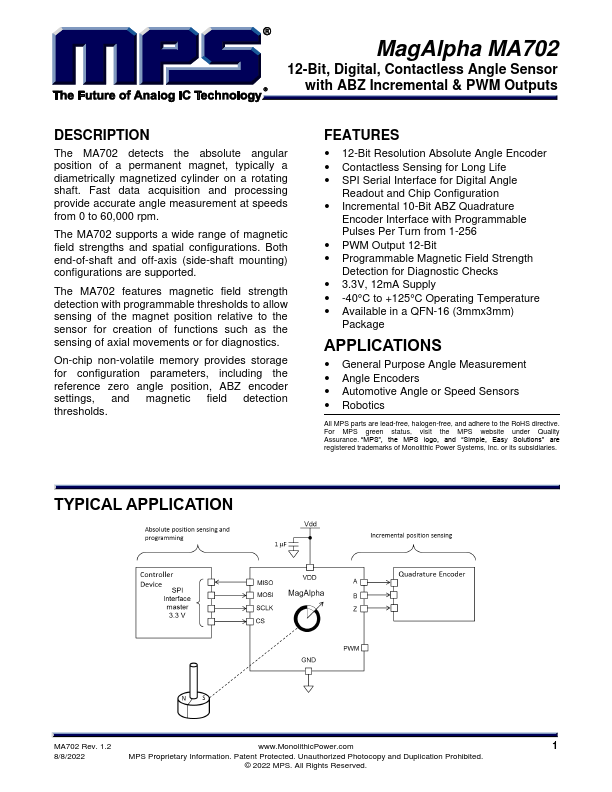
The MA702 detects the absolute angular position of a permanent magnet, typically a diametrically magnetized cylinder on a rotating shaft.

Fast data acquisition and processing provide accurate angle measurement at speeds from 0 to 60,000 rpm.

Features

  • magnetic field strength detection with programmable thresholds to allow sensing of the magnet position relative to the sensor for creation of functions such as the sensing of axial movements or for diagnostics. On-chip non-volatile memory provides storage for configuration parameters, including the reference zero angle position, ABZ encoder settings, and magnetic field detection thresholds.

📥 Download Datasheet

Note: The manufacturer provides a single datasheet file (MA702-MPS.pdf) that lists specifications for multiple related part numbers.

Full PDF Text Transcription (Reference)

The following content is an automatically extracted verbatim text from the original manufacturer datasheet and is provided for reference purposes only.

View original datasheet text
MagAlpha MA702 12-Bit, Digital, Contactless Angle Sensor with ABZ Incremental & PWM Outputs DESCRIPTION The MA702 detects the absolute angular position of a permanent magnet, typically a diametrically magnetized cylinder on a rotating shaft. Fast data acquisition and processing provide accurate angle measurement at speeds from 0 to 60,000 rpm. The MA702 supports a wide range of magnetic field strengths and spatial configurations. Both end-of-shaft and off-axis (side-shaft mounting) configurations are supported. The MA702 features magnetic field strength detection with programmable thresholds to allow sensing of the magnet position relative to the sensor for creation of functions such as the sensing of axial movements or for diagnostics.
Published: |