• Part: S30D150C
  • Description: Schottky Barrier Rectifiers
  • Manufacturer: Mospec Semiconductor
  • Size: 193.15 KB
Download S30D150C Datasheet PDF
Mospec Semiconductor
S30D150C
S30D150C is Schottky Barrier Rectifiers manufactured by Mospec Semiconductor.
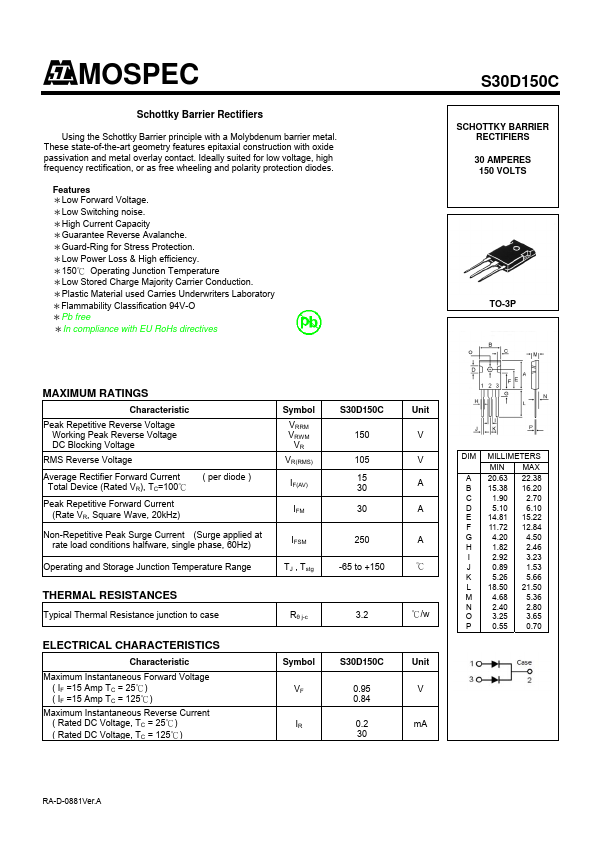
features epitaxial construction with oxide passivation and metal overlay contact. Ideally suited for low voltage, high frequency rectification, or as free wheeling and polarity protection diodes. Features *Low Forward Voltage. *Low Switching noise. *High Current Capacity *Guarantee Reverse Avalanche. *Guard-Ring for Stress Protection. *Low Power Loss & High efficiency. *150℃ Operating Junction Temperature *Low Stored Charge Majority Carrier Conduction. *Plastic Material used Carries Underwriters Laboratory *Flammability Classification 94V-O *Pb free *In pliance with EU Ro Hs directives SCHOTTKY BARRIER RECTIFIERS 30 AMPERES 150 VOLTS TO-3P MAXIMUM RATINGS Characteristic Peak Repetitive Reverse Voltage Working Peak Reverse Voltage DC Blocking Voltage RMS Reverse Voltage Average Rectifier Forward Current Total Device (Rated VR), TC=100℃ Peak Repetitive Forward Current (Rate VR, Square Wave, 20k Hz) ( per diode ) Non-Repetitive Peak Surge Current (Surge applied at rate load conditions halfware, single phase, 60Hz) Operating and Storage Junction Temperature Range Symbol VRRM VRWM VR VR(RMS) IF(AV) IFSM TJ , Tstg THERMAL RESISTANCES Typical Thermal Resistance junction to case Rθ j-c ELECTRICAL CHARACTERISTICS Characteristic Maximum Instantaneous Forward Voltage ( IF =15 Amp TC = 25℃) ( IF =15 Amp TC = 125℃) Maximum Instantaneous Reverse Current ( Rated DC Voltage, TC = 25℃) ( Rated DC Voltage, TC = 125℃) Symbol VF IR S30D150C 150 105 15 30 30 250 -65 to +150 S30D150C 0.95 0.84 0.2 30 Unit V V A A A ℃ ℃/w Unit V m A DIM MILLIMETERS MIN MAX A 20.63 22.38 B 15.38 16.20 C 1.90 2.70 D 5.10 6.10 E 14.81 15.22 F 11.72 12.84 G 4.20 4.50 H 1.82 2.46 I 2.92 3.23 J 0.89 1.53 K 5.26 5.66 L 18.50 21.50 M 4.68 5.36 N 2.40 2.80 O 3.25 3.65 P 0.55 0.70 RA-D-0881Ver.A MOSPEC FIG-1 FORWARD CURRENT DERATING CURVE FIG-2 TYPICAL FORWARD CHARACTERISTICS...