
Datasheet Details
| Part number | AT-213-PIN |
|---|---|
| Manufacturer | MACOM Technology Solutions |
| File Size | 595.04 KB |
| Description | Digital Attenuator |
| Datasheet |
 AT-213-PIN Datasheet AT-213-PIN Datasheet
|
|
|

Download the AT-213-PIN datasheet PDF. This datasheet also covers the AT-213-PIN-MA variant, as both devices belong to the same digital attenuator family and are provided as variant models within a single manufacturer datasheet.
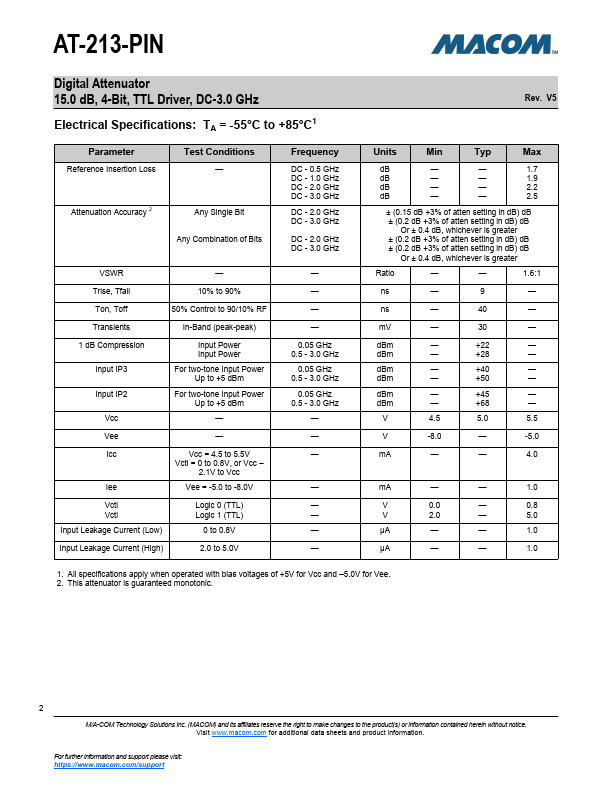
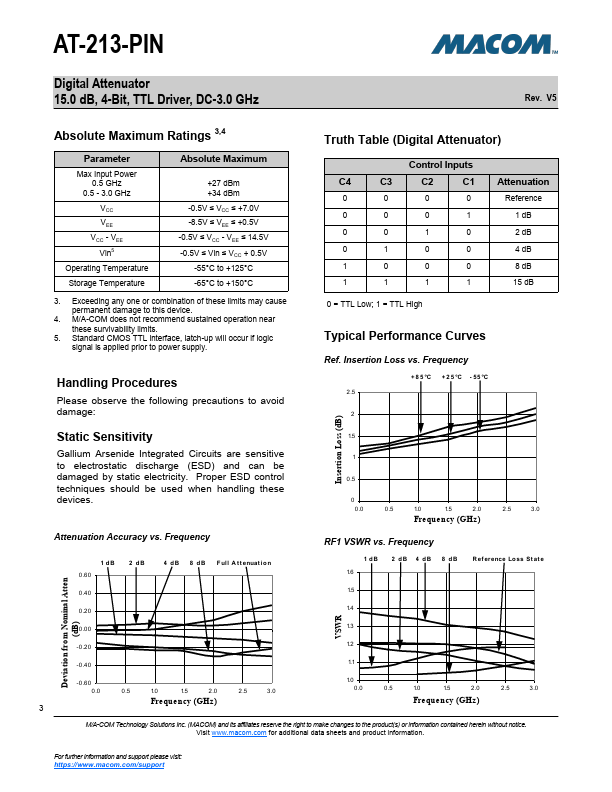
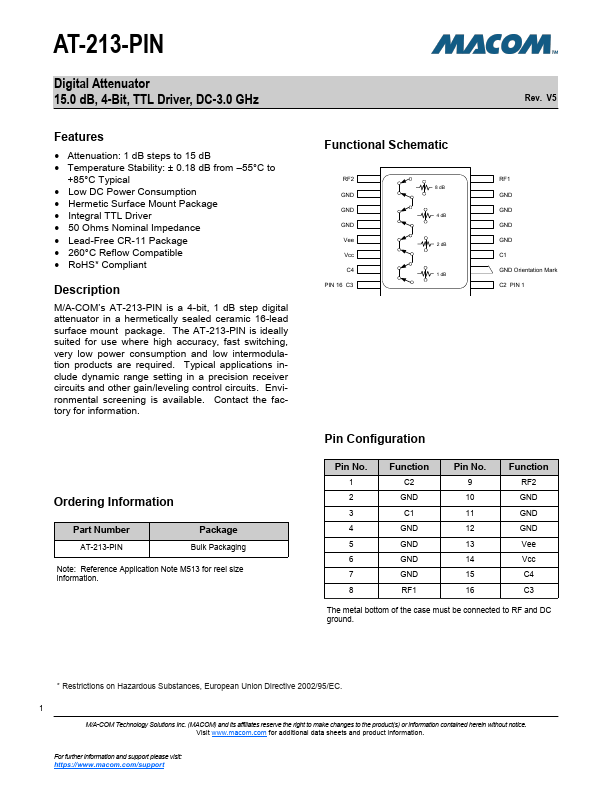
M/A-COM’s AT-213-PIN is a 4-bit, 1 dB step digital attenuator in a hermetically sealed ceramic 16-lead surface mount package.
The AT-213-PIN is ideally suited for use where high accuracy, fast switching, very low power consumption and low intermodulation products are required.
| Part number | AT-213-PIN |
|---|---|
| Manufacturer | MACOM Technology Solutions |
| File Size | 595.04 KB |
| Description | Digital Attenuator |
| Datasheet |
AT-213-PIN Datasheet
|
|
|
|
| Part Number | Description | Manufacturer |
|---|---|---|
| AT-213 | Digital Attenuator | Tyco Electronics |
| AT-210 | Digital Attenuator | Tyco Electronics |
| AT-220 | Digital Attenuator | Tyco Electronics |
| AT-226 | Digital Attenuator | Tyco Electronics |
| AT-230 | Digital Attenuator | Tyco Electronics |
| Part Number | Description |
|---|---|
| AT-259 | Voltage Variable Absorptive Attenuator |
The following content is an automatically extracted verbatim text from the original manufacturer datasheet and is provided for reference purposes only.