Datasheet4U Logo Datasheet4U.com

EL7641A - (EL7640A - EL7642A) TFT-LCD DC/DC

Download the EL7641A datasheet PDF. This datasheet also covers the EL7640A variant, as both devices belong to the same (el7640a - el7642a) tft-lcd dc/dc family and are provided as variant models within a single manufacturer datasheet.

General Description

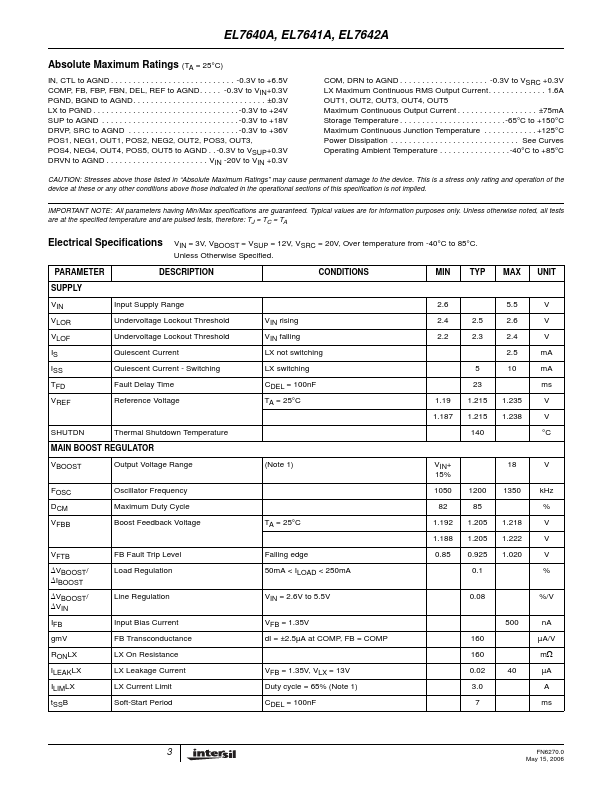
Input Supply Range Undervoltage Lockout Threshold Undervoltage Lockout Threshold Quiescent Current Quiescent Current - Switching Fault Delay Time Reference Voltage VIN rising VIN falling LX not switching LX switching CDEL = 100nF TA = 25°C 2.6 2.4 2.2 2.5 2.3 5.5 2.6 2.4 2.5 5 23 10 V V V mA mA

Key Features

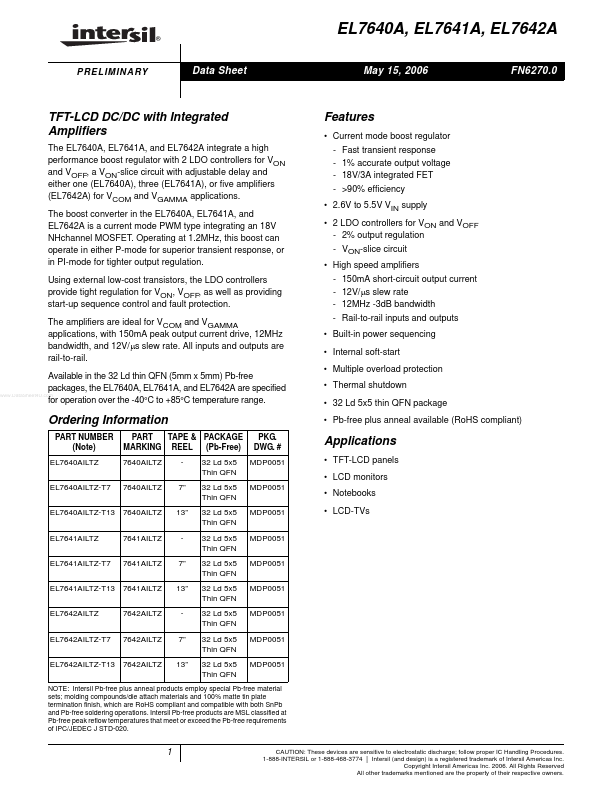
  • Current mode boost regulator - Fast transient response - 1% accurate output voltage - 18V/3A integrated FET - >90% efficiency.
  • 2.6V to 5.5V VIN supply.
  • 2 LDO controllers for VON and VOFF - 2% output regulation - VON-slice circuit.
  • High speed amplifiers - 150mA short-circuit output current - 12V/µs slew rate - 12MHz -3dB bandwidth - Rail-to-rail inputs and outputs.
  • Built-in power sequencing.
  • Internal soft-start.
  • Multiple overload pro.

📥 Download Datasheet

Note: The manufacturer provides a single datasheet file (EL7640A_IntersilCorporation.pdf) that lists specifications for multiple related part numbers.

Full PDF Text Transcription (Reference)

The following content is an automatically extracted verbatim text from the original manufacturer datasheet and is provided for reference purposes only.

View original datasheet text
® EL7640A, EL7641A, EL7642A Data Sheet May 15, 2006 FN6270.0 PRELIMINARY TFT-LCD DC/DC with Integrated Amplifiers The EL7640A, EL7641A, and EL7642A integrate a high performance boost regulator with 2 LDO controllers for VON and VOFF, a VON-slice circuit with adjustable delay and either one (EL7640A), three (EL7641A), or five amplifiers (EL7642A) for VCOM and VGAMMA applications. The boost converter in the EL7640A, EL7641A, and EL7642A is a current mode PWM type integrating an 18V NHchannel MOSFET. Operating at 1.2MHz, this boost can operate in either P-mode for superior transient response, or in PI-mode for tighter output regulation.