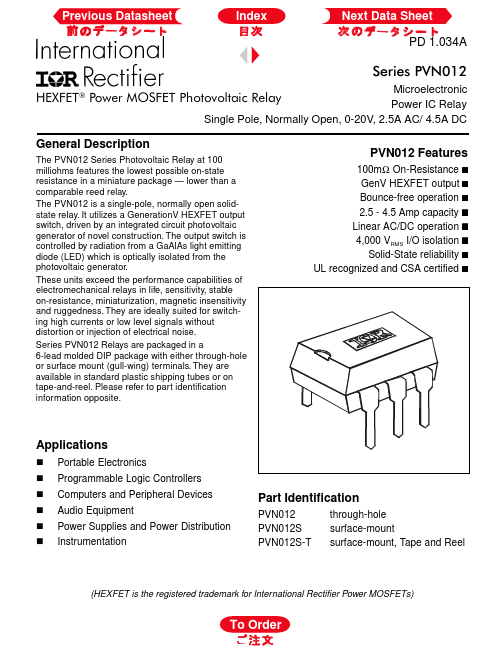

PVN012
PVN012 is Power MOSFET manufactured by International Rectifier.
escription
The PVN012 Series Photovoltaic Relay at 100 milliohms Features the lowest possible on-state resistance in a miniature package
- lower than a parable reed relay. The PVN012 is a single-pole, normally open solidstate relay. It utilizes a Generation V HEXFET output switch, driven by an integrated circuit photovoltaic generator of novel construction. The output switch is controlled by radiation from a Ga Al As light emitting diode (LED) which is optically isolated from the photovoltaic generator. These units exceed the performance capabilities of electromechanical relays in life, sensitivity, stable on-resistance, miniaturization, magnetic insensitivity and ruggedness. They are ideally suited for switching high currents or low level signals without distortion or injection of electrical noise. Series PVN012 Relays are packaged in a 6-lead molded DIP package with either through-hole or surface mount (gull-wing) terminals. They are available in standard plastic shipping tubes or on tape-and-reel. Please refer to part identification information opposite.
Microelectronic Power IC Relay Single Pole, Normally Open, 0-20V, 2.5A AC/ 4.5A DC
PVN012 Features
100mΩ On-Resistance s Gen V HEXFET output s Bounce-free operation s 2.5
- 4.5 Amp capacity s Linear AC/DC operation s 4,000 VRMS I/O isolation s Solid-State reliability s UL recognized and CSA certified s
Applications n n n n n n Portable Electronics Programmable Logic Controllers puters and Peripheral Devices Audio Equipment Power Supplies and Power Distribution Instrumentation
Part Identification
PVN012 PVN012S PVN012S-T through-hole surface-mount surface-mount, Tape and Reel
(HEXFET is the registered trademark for International Rectifier Power MOSFETs)
To Order
Previous Datasheet
Index
Next Data Sheet
Series PVN012 HEXFET® Photovoltaic Relay
Electrical Specifications (-40°C ≤ TA ≤ +85°C unless otherwise specified) INPUT CHARACTERISTICS
Minimum Control Current (see figure 1) Maximum Control Current for...