• Part: TLE8881-2
  • Description: Alternator Controller
  • Manufacturer: Infineon
  • Size: 5.46 MB
Download TLE8881-2 Datasheet PDF
Infineon
TLE8881-2
TLE8881-2 is Alternator Controller manufactured by Infineon.
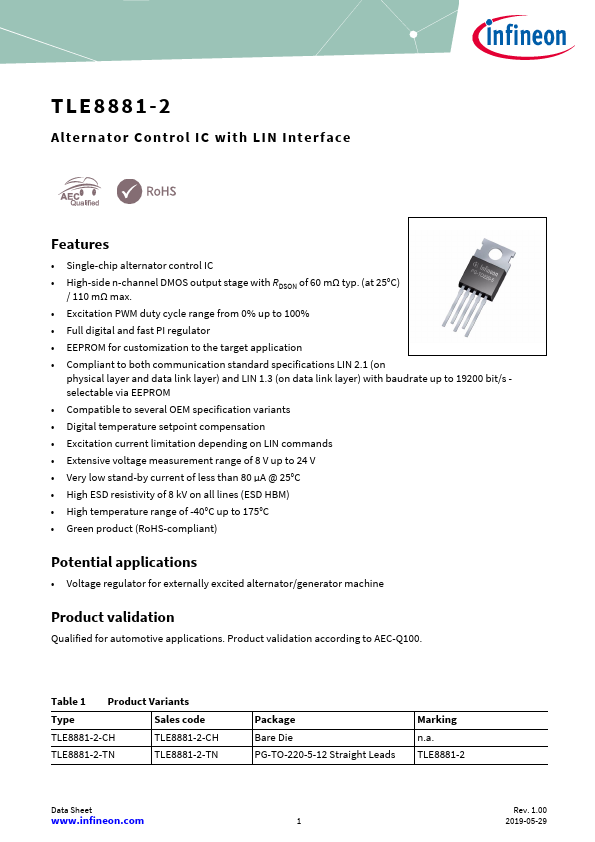
Features - Single-chip alternator control IC - High-side n-channel DMOS output stage with RDSON of 60 mΩ typ. (at 25°C) / 110 mΩ max. - Excitation PWM duty cycle range from 0% up to 100% - Full digital and fast PI regulator - EEPROM for customization to the target application - pliant to both munication standard specifications LIN 2.1 (on physical layer and data link layer) and LIN 1.3 (on data link layer) with baudrate up to 19200 bit/s selectable via EEPROM - patible to several OEM specification variants - Digital temperature setpoint pensation - Excitation current limitation depending on LIN mands - Extensive voltage measurement range of 8 V up to 24 V - Very low stand-by current of less than 80 μA @ 25°C - High ESD resistivity of 8 k V on all lines (ESD HBM) - High temperature range of -40°C up to 175°C - Green product (Ro HS-pliant) Potential applications - Voltage regulator for externally excited alternator/generator machine Product validation Qualified for automotive applications. Product validation according to AEC-Q100. Table 1 Product Variants Type Sales code TLE8881-2-CH TLE8881-2-CH TLE8881-2-TN TLE8881-2-TN Package Bare Die PG-TO-220-5-12 Straight Leads Marking n.a. TLE8881-2 Data Sheet .infineon. Rev. 1.00 2019-05-29 Alternator Control IC with LIN Interface Description The device is based on Infineon’s power technology SPT which allows bipolar and CMOS control circuitry to be integrated with DMOS power devices on the same monolithic circuitry. The battery voltage is regulated at a precise value between 10.6 V and 16 V. In case of munication loss, the regulator is able to proceed with the voltage regulation by using adjustable default values. A fixed frequency PWM voltage is set at an output pin to excite the excitation coil of the alternator. The TLE8881-2 is equipped with special protection circuitry as well as circuitry to control the excitation voltage slew rate to reduce EMI. Therefore the device meets the specific ESD and...