
• Part: GS8662S08E-333
  • Description: DDR SigmaSIO-II SRAM
  • Manufacturer: GSI Technology
  • Size: 2.29 MB
Download GS8662S08E-333 Datasheet PDF
GSI Technology
GS8662S08E-333
GS8662S08E-333 is DDR SigmaSIO-II SRAM manufactured by GSI Technology.
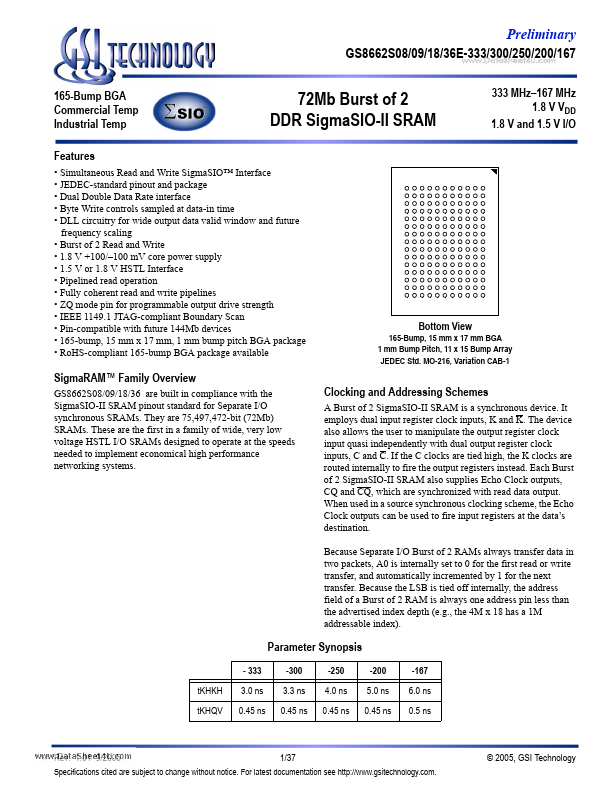
Preliminary GS8662S08/09/18/36E-333/300/250/200/167 .. 165-Bump BGA mercial Temp Industrial Temp Features - Simultaneous Read and Write Sigma SIO™ Interface - JEDEC-standard pinout and package - Dual Double Data Rate interface - Byte Write controls sampled at data-in time - DLL circuitry for wide output data valid window and future frequency scaling - Burst of 2 Read and Write - 1.8 V +100/- 100 m V core power supply - 1.5 V or 1.8 V HSTL Interface - Pipelined read operation - Fully coherent read and write pipelines - ZQ mode pin for programmable output drive strength - IEEE 1149.1 JTAG-pliant Boundary Scan - Pin-patible with future 144Mb devices - 165-bump, 15 mm x 17 mm, 1 mm bump pitch BGA package - Ro HS-pliant 165-bump BGA package available 72Mb Burst of 2 DDR Sigma SIO-II SRAM 333 MHz- 167 MHz 1.8 V VDD 1.8 V and 1.5 V I/O Bottom View 165-Bump, 15 mm x 17 mm BGA 1 mm Bump Pitch, 11 x 15 Bump Array JEDEC Std. MO-216, Variation CAB-1 Sigma RAM™ Family Overview GS8662S08/09/18/36 are built in pliance with the Sigma SIO-II SRAM pinout standard for Separate I/O synchronous SRAMs. They are 75,497,472-bit (72Mb) SRAMs. These are the first in a family of wide, very low voltage HSTL I/O SRAMs designed to operate at the speeds needed to implement economical high performance networking systems. Clocking and Addressing Schemes A Burst of 2 Sigma SIO-II SRAM is a synchronous device. It employs dual input register clock inputs, K and K. The device also allows the user to manipulate the output register clock input quasi independently with dual output register clock inputs, C and C. If the C clocks are tied high, the K clocks are routed internally to fire the output registers instead. Each Burst of 2 Sigma SIO-II SRAM also supplies Echo Clock outputs, CQ and CQ, which are synchronized with read data output. When used in a source synchronous clocking scheme, the Echo Clock outputs can be used to fire input registers at the data’s destination....