Datasheet4U Logo Datasheet4U.com

MB2MT - Glass Passivated Bridge Rectifiers

Download the MB2MT datasheet PDF. This datasheet also covers the MB2MT-GOOD variant, as both devices belong to the same glass passivated bridge rectifiers family and are provided as variant models within a single manufacturer datasheet.

Features

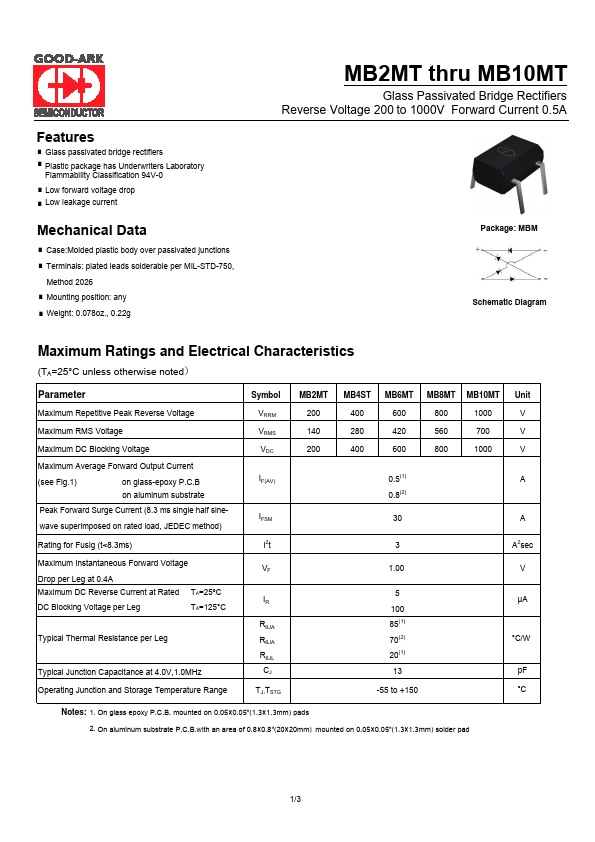
  • Glass passivated bridge rectifiers.
  • Plastic package has Underwriters Laboratory Flammability Classification 94V-0.
  • Low forward voltage drop.
  • Low leakage current Mechanical Data.
  • Case:Molded plastic body over passivated junctions.
  • Terminals: plated leads solderable per MIL-STD-750, Method 2026.
  • Mounting position: any.
  • Weight: 0.078oz. , 0.22g MB2MT thru MB10MT Glass Passivated Bridge Rectifiers Reverse Voltage 200 to 1000V Forward Current 0.5A Package: MBM.

📥 Download Datasheet

Note: The manufacturer provides a single datasheet file (MB2MT-GOOD-ARK.pdf) that lists specifications for multiple related part numbers.

Datasheet Details

Part number MB2MT
Manufacturer GOOD-ARK
File Size 513.31 KB
Description Glass Passivated Bridge Rectifiers
Datasheet download datasheet MB2MT Datasheet

Full PDF Text Transcription (Reference)

The following content is an automatically extracted verbatim text from the original manufacturer datasheet and is provided for reference purposes only.

View original datasheet text
Features ■ Glass passivated bridge rectifiers ■ Plastic package has Underwriters Laboratory Flammability Classification 94V-0 ■ Low forward voltage drop ■ Low leakage current Mechanical Data ■ Case:Molded plastic body over passivated junctions ■ Terminals: plated leads solderable per MIL-STD-750, Method 2026 ■ Mounting position: any ■ Weight: 0.078oz., 0.22g MB2MT thru MB10MT Glass Passivated Bridge Rectifiers Reverse Voltage 200 to 1000V Forward Current 0.5A Package: MBM Schematic Diagram Maximum Ratings and Electrical Characteristics (TA=25°C unless otherwise noted) Parameter Maximum Repetitive Peak Reverse Voltage Maximum RMS Voltage Maximum DC Blocking Voltage Maximum Average Forward Output Current (see Fig.1) on glass-epoxy P.C.