• Part: MB89613R
  • Description: 8-bit Proprietary Microcontroller
  • Category: Microcontroller
  • Manufacturer: Fujitsu Semiconductor Limited
  • Size: 1.00 MB
Download MB89613R Datasheet PDF
Fujitsu Semiconductor Limited
MB89613R
MB89613R is 8-bit Proprietary Microcontroller manufactured by Fujitsu Semiconductor Limited.
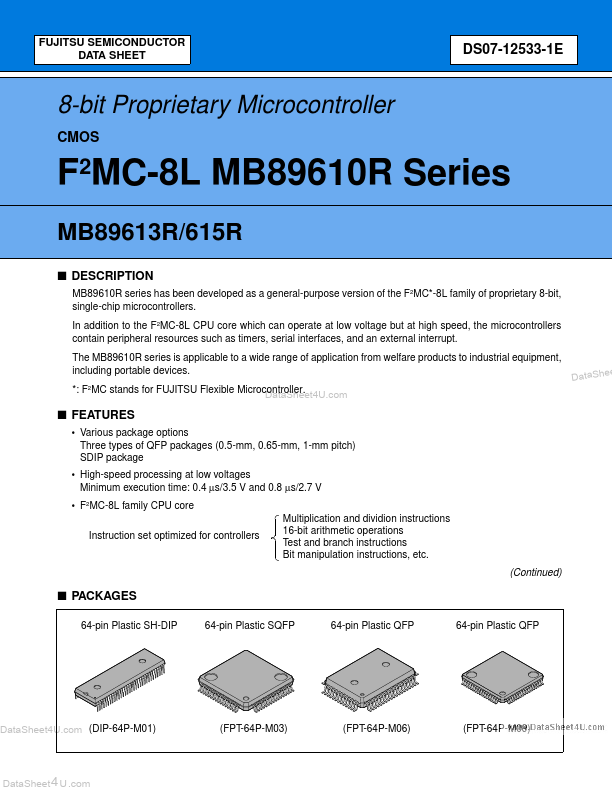
.. FUJITSU SEMICONDUCTOR DATA SHEET DS07-12533-1E 8-bit Proprietary Microcontroller CMOS F2MC-8L MB89610R Series MB89613R/615R s DESCRIPTION MB89610R series has been developed as a general-purpose version of the F2MC- -8L family of proprietary 8-bit, single-chip microcontrollers. In addition to the F2MC-8L CPU core which can operate at low voltage but at high speed, the microcontrollers contain peripheral resources such as timers, serial interfaces, and an external interrupt. The MB89610R series is applicable to a wide range of application from welfare products to industrial equipment, including portable devices. - : F2MC stands for FUJITSU Flexible Microcontroller. . e Data She s Features - Various package options Three types of QFP packages (0.5-mm, 0.65-mm, 1-mm pitch) SDIP package - High-speed processing at low voltages Minimum execution time: 0.4 µs/3.5 V and 0.8 µs/2.7 V - F2MC-8L family CPU core Instruction set optimized for controllers Multiplication and dividion instructions 16-bit arithmetic operations Test and branch instructions Bit manipulation instructions, etc. (Continued) s PACKAGES 64-pin Plastic SH-DIP 64-pin Plastic SQFP 64-pin Plastic QFP 64-pin Plastic QFP . (DIP-64P-M01) (FPT-64P-M03) (FPT-64P-M06) (FPT-64P-M09) Data Sheet 4 U . .. MB89610R Series (Continued) - Four types of timers 8-bit PWM timer (also usable a reload timer) 8-bit pulse-width count timer (Continuous measurement capable, applicable to remote control, etc) 16-bit timer/counter 20-bit time-base timer - Two serial interfaces Switchable transfer direction allows munication with various equipment. - External interrupt: 4 channels Four channels are independent and capable of wake-up from low-power consumption modes (with an edge detection function). - Low-power consumption modes Stop mode (Oscillation stops to minimize the current consumption.) Sleep mode (The CPU stops to reduce the current consumption...