
Datasheet4U Logo Datasheet4U.com

FMS6403MTC20 - Triple Video Drivers w/Selectable HD/Progressive/SD/ Bypass Filters for RGB and YPbPr Signals

Description

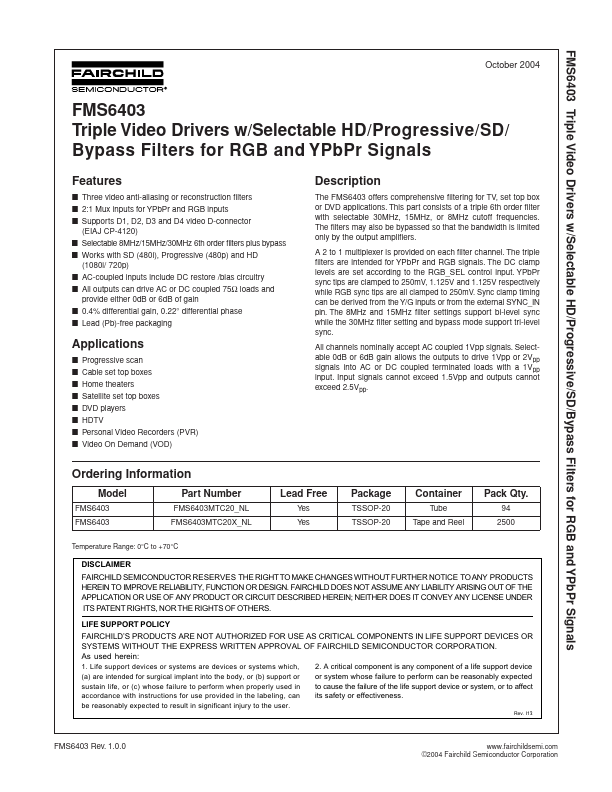
The FMS6403 offers comprehensive filtering for TV, set top box or DVD applications.

This part consists of a triple 6th order filter with selectable 30MHz, 15MHz, or 8MHz cutoff frequencies.

The filters may also be bypassed so that the bandwidth is limited only by the output amplifiers.

Features

  • Three video anti-aliasing or reconstruction filters.
  • 2:1 Mux inputs for YPbPr and RGB inputs.
  • Supports D1, D2, D3 and D4 video D-connector (EIAJ CP-4120).
  • Selectable 8MHz/15MHz/30MHz 6th order filters plus bypass.
  • Works with SD (480i), Progressive (480p) and HD (1080i/ 720p).
  • AC-coupled inputs include DC restore /bias circuitry.
  • All outputs can drive AC or DC coupled 75Ω loads and provide either 0dB or 6dB of gain.
  • 0.4% differential gain, 0.22° differential.

📥 Download Datasheet

Datasheet preview – FMS6403MTC20

Datasheet Details

Part number FMS6403MTC20
Manufacturer Fairchild Semiconductor (now onsemi)
File Size 426.65 KB
Description Triple Video Drivers w/Selectable HD/Progressive/SD/ Bypass Filters for RGB and YPbPr Signals
Datasheet download datasheet FMS6403MTC20 Datasheet
Additional preview pages of the FMS6403MTC20 datasheet.
Other Datasheets by Fairchild Semiconductor

Full PDF Text Transcription

Click to expand full text
FMS6403 Triple Video Drivers w/Selectable HD/Progressive/SD/Bypass Filters for RGB and YPbPr Signals October 2004 FMS6403 Triple Video Drivers w/Selectable HD/Progressive/SD/ Bypass Filters for RGB and YPbPr Signals Features ■ Three video anti-aliasing or reconstruction filters ■ 2:1 Mux inputs for YPbPr and RGB inputs ■ Supports D1, D2, D3 and D4 video D-connector (EIAJ CP-4120) ■ Selectable 8MHz/15MHz/30MHz 6th order filters plus bypass ■ Works with SD (480i), Progressive (480p) and HD (1080i/ 720p) ■ AC-coupled inputs include DC restore /bias circuitry ■ All outputs can drive AC or DC coupled 75Ω loads and provide either 0dB or 6dB of gain ■ 0.4% differential gain, 0.
Published: |