
CY7C335
Overview
- 100-MHz output registered operation
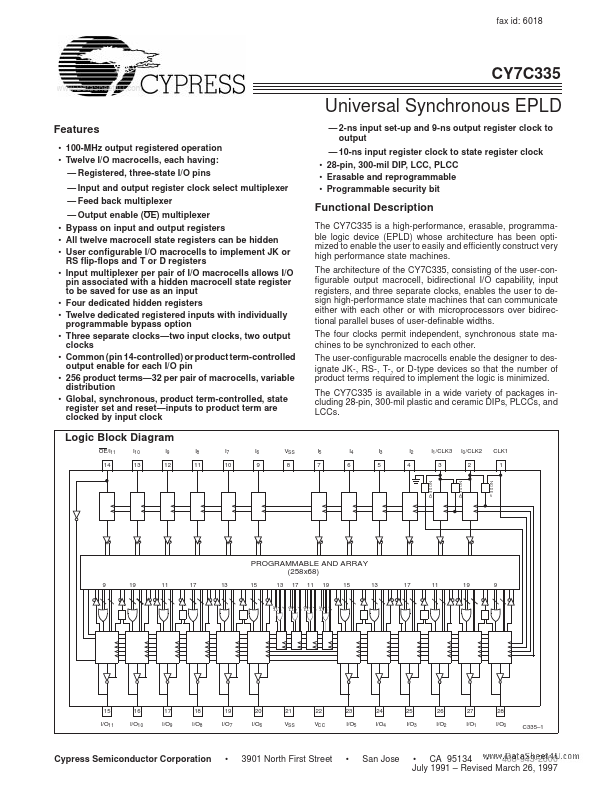
- Twelve I/O macrocells, each having: - Registered, three-state I/O pins - Input and output register clock select multiplexer - Feed back multiplexer * * * * * * * * *
- - Output enable (OE) multiplexer Bypass on input and output registers All twelve macrocell state registers can be hidden User configurable I/O macrocells to implement JK or RS flip-flops and T or D registers Input multiplexer per pair of I/O macrocells allows I/O pin associated with a hidden macrocell state register to be saved for use as an input Four dedicated hidden registers Twelve dedicated registered inputs with individually programmable bypass option Three separate clocks-two input clocks, two output clocks Common (pin 14-controlled) or product term-controlled output enable for each I/O pin 256 product terms-32 per pair of macrocells, variable distribution Global, synchronous, product term-controlled, state register set and reset-inputs to product term are clocked by input clock - 2-ns input set-up and 9-ns output register clock to output - 10-ns input register clock to state register clock
- 28-pin, 300-mil DIP, LCC, PLCC
- Erasable and reprogrammable
- Programmable security bit Functional Description The CY7C335 is a high-performance, erasable, programmable logic device (EPLD) whose architecture has been optimized to enable the user to easily and efficiently construct very high performance state machines. The architecture of the CY7C335, consisting of the user-configurable output macrocell, bidirectional I/O capability, input registers, and three separate clocks, enables the user to design high-performance state machines that can communicate either with each other or with microprocessors over bidirectional parallel buses of user-definable widths. The four clocks permit independent, synchronous state machines to be s