• Part: CY7C1464AV33
  • Description: (CY7C146xAV33) 36-Mbit Pipelined SRAM
  • Manufacturer: Cypress
  • Size: 833.98 KB
Download CY7C1464AV33 Datasheet PDF
Cypress
CY7C1464AV33
CY7C1464AV33 is (CY7C146xAV33) 36-Mbit Pipelined SRAM manufactured by Cypress.
- Part of the CY7C1460AV33 comparator family.
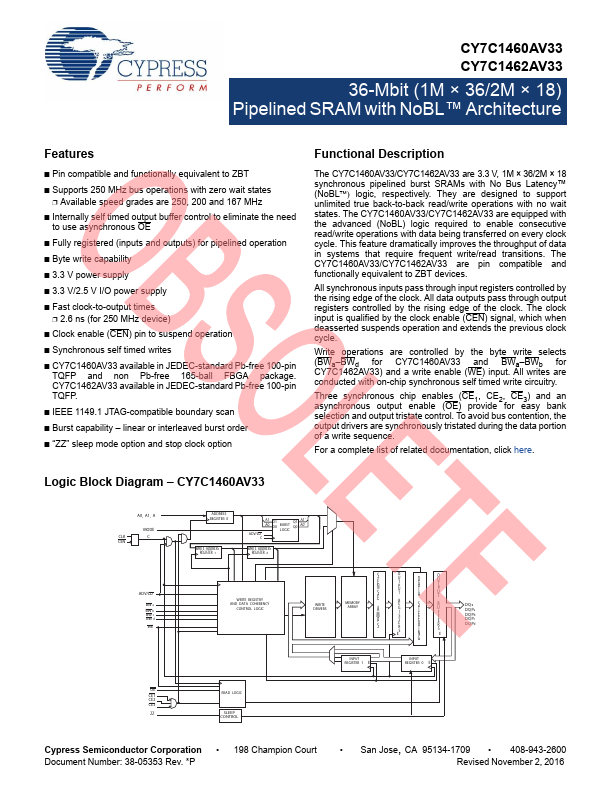
CY7C1460AV33 CY7C1462AV33 36-Mbit (1M × 36/2M × 18) Pipelined SRAM with No BL™ Architecture 36-Mbit (1M × 36/2M × 18) Pipelined SRAM with No BL™ Architecture Features - Pin patible and functionally equivalent to ZBT - Supports 250 MHz bus operations with zero wait states - Available speed grades are 250, 200 and 167 MHz - Internally self timed output buffer control to eliminate the need to use asynchronous OE - Fully registered (inputs and outputs) for pipelined operation - Byte write capability - 3.3 V power supply - 3.3 V/2.5 V I/O power supply - Fast clock-to-output times - 2.6 ns (for 250 MHz device) - Clock enable (CEN) pin to suspend operation - Synchronous self timed writes - CY7C1460AV33 available in JEDEC-standard Pb-free 100-pin TQFP and non Pb-free 165-ball FBGA package. CY7C1462AV33 available in JEDEC-standard Pb-free 100-pin TQFP. - IEEE 1149.1 JTAG-patible boundary scan - Burst capability - linear or interleaved burst order - “ZZ” sleep mode option and stop clock option Functional Description The CY7C1460AV33/CY7C1462AV33 are 3.3 V, 1M × 36/2M × 18 synchronous pipelined burst SRAMs with No Bus Latency™ (No BL logic, respectively. They are designed to support unlimited true back-to-back read/write operations with no wait states. The CY7C1460AV33/CY7C1462AV33 are equipped with the advanced (No BL) logic required to enable consecutive read/write operations with data being transferred on every clock cycle. This feature dramatically improves the throughput of data in systems that require frequent write/read transitions. The CY7C1460AV33/CY7C1462AV33 are pin patible and functionally equivalent to ZBT devices. All synchronous inputs pass through input registers controlled by the rising edge of the clock. All data outputs pass through output registers controlled by the rising edge of the clock. The clock input is qualified by the clock enable (CEN) signal, which when deasserted suspends operation and extends the previous clock cycle. Write...