Datasheet4U Logo Datasheet4U.com

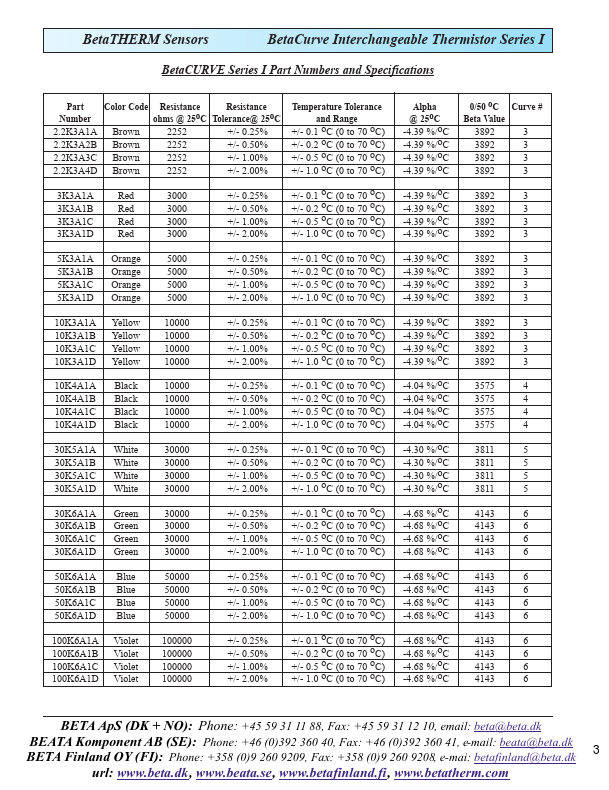
5K3A1A - Chip Thermistors

Download the 5K3A1A datasheet PDF. This datasheet also covers the 3K3A1A variant, as both devices belong to the same chip thermistors family and are provided as variant models within a single manufacturer datasheet.

Features

  • Rapid Time Response (1 second typical in liquids).
  • DC (Dissipation Constant) = 0.75mW/oC typical in still air at 25oC.
  • Min. /Max. Temperature Exposure = -80oC to 150oC.
  • Available in custom probe assemblies.
  • Proven Stability and Reliability.
  • Alloy Lead Wires for reduced thermal conductivity ("stem effect").
  • Choice of 4 temperature tolerance classifications. Tolerance Code: A B C D Specification: +/-0.1oC, 0oC to 70oC +/-0.2oC, 0oC to 70oC +/-0.5oC, 0oC t.

📥 Download Datasheet

Note: The manufacturer provides a single datasheet file (3K3A1A-xx.pdf) that lists specifications for multiple related part numbers.

Datasheet Details

Part number 5K3A1A
Manufacturer BetaTHERM
File Size 303.10 KB
Description Chip Thermistors
Datasheet download datasheet 5K3A1A Datasheet

Full PDF Text Transcription (Reference)

The following content is an automatically extracted verbatim text from the original manufacturer datasheet and is provided for reference purposes only.

View original datasheet text
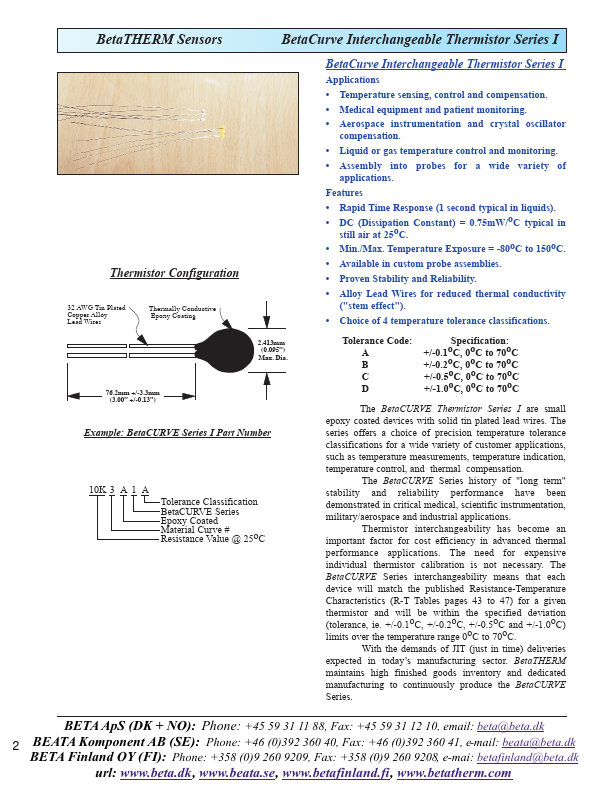
BetaTHERM Sensors BetaCurve Interchangeable Thermistor Series I Thermistor Configuration 32 AWG Tin Plated Copper Alloy Lead Wires Thermally Conductive Epoxy Coating 2.413mm (0.095Ó) Max. Dia. 76.2mm +/-3.3mm (3.00Ó +/-0.13Ó) Example: BetaCURVE Series I Part Number 10K 3 A 1 A Tolerance Classification BetaCURVE Series Epoxy Coated Material Curve # Resistance Value @ 25oC BetaCurve Interchangeable Thermistor Series I Applications ¥ Temperature sensing, control and compensation. ¥ Medical equipment and patient monitoring. ¥ Aerospace instrumentation and crystal oscillator compensation. ¥ Liquid or gas temperature control and monitoring. ¥ Assembly into probes for a wide variety of applications. Features ¥ Rapid Time Response (1 second typical in liquids).
Published: |