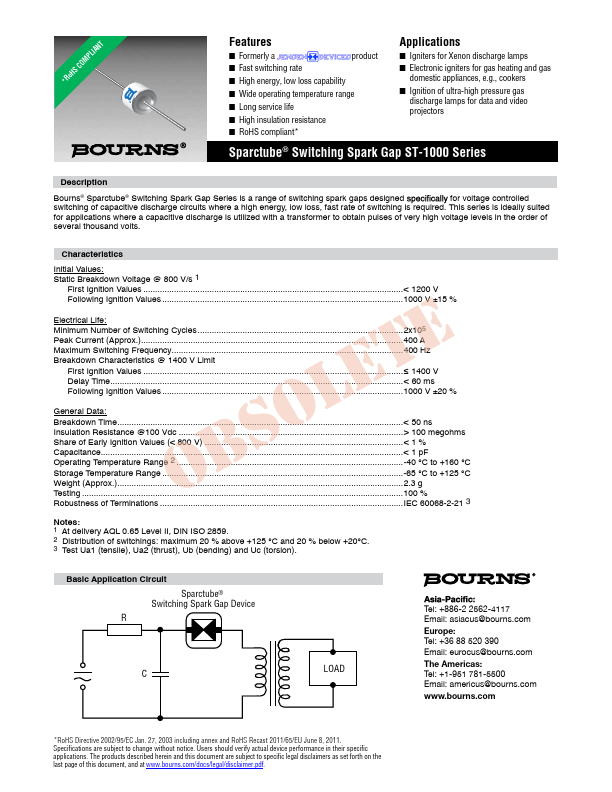

ST-1000
ST-1000 is Switching Spark Gap manufactured by Bourns.
- Ro HS PLIANT
Features
- Formerly a product
- Fast switching rate
- High energy, low loss capability
- Wide operating temperature range
- Long service life
- High insulation resistance
- Ro HS pliant-
Applications
- Igniters for Xenon discharge lamps
- Electronic igniters for gas heating and gas domestic appliances, e.g., cookers
- Ignition of ultra-high pressure gas discharge lamps for data and video projectors
Sparctube® Switching Spark Gap ST-1000 Series
Description
Bourns® Sparctube® Switching Spark Gap Series is a range of switching spark gaps designed for voltage controlled switching of capacitive discharge circuits where a high energy, low loss, fast rate of switching is required. This series is ideally suited for applications where a capacitive discharge is utilized with a transformer to obtain pulses of very high voltage levels in the order of several thousand volts.
Characteristics
Initial Values: Static Breakdown Voltage @ 800 V/s 1
First Ignition Values ..............................................................................................................< 1200 V Following Ignition Values ......................................................................................................1000 V ±15 %
OBSOLETE Electrical Life:
Minimum Number of Switching Cycles .......................................................................................2x105 Peak Current (Approx.)...............................................................................................................400 A Maximum Switching Frequency..................................................................................................400 Hz Breakdown Characteristics @ 1400 V Limit
First Ignition Values ..............................................................................................................≤ 1400 V Delay Time............................................................................................................................