Datasheet4U Logo Datasheet4U.com

SAM3U2C - SMART ARM-based Flash MCU

Download the SAM3U2C datasheet PDF. This datasheet also covers the SAM3U variant, as both devices belong to the same smart arm-based flash mcu family and are provided as variant models within a single manufacturer datasheet.

Description

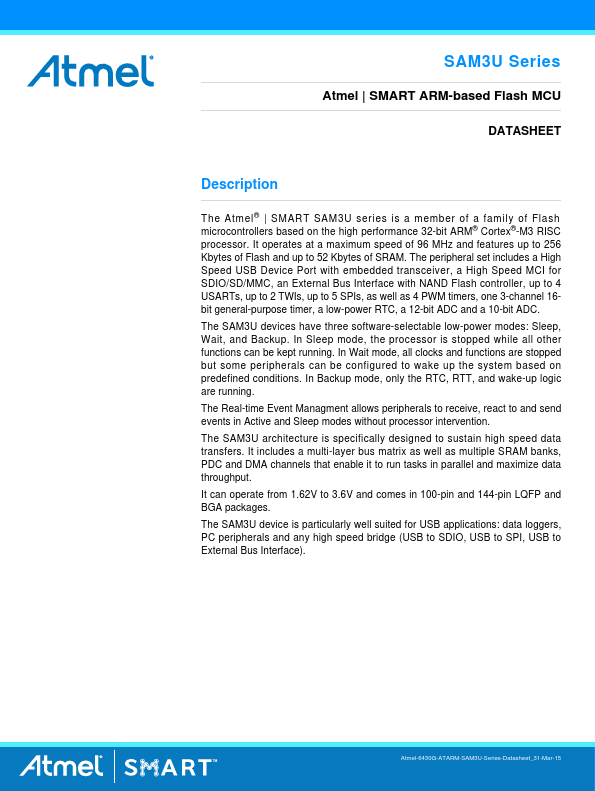
The Atmel® | SMART SAM3U series is a member of a family of Flash microcontrollers based on the high performance 32-bit ARM® Cortex®-M3 RISC processor.

Features

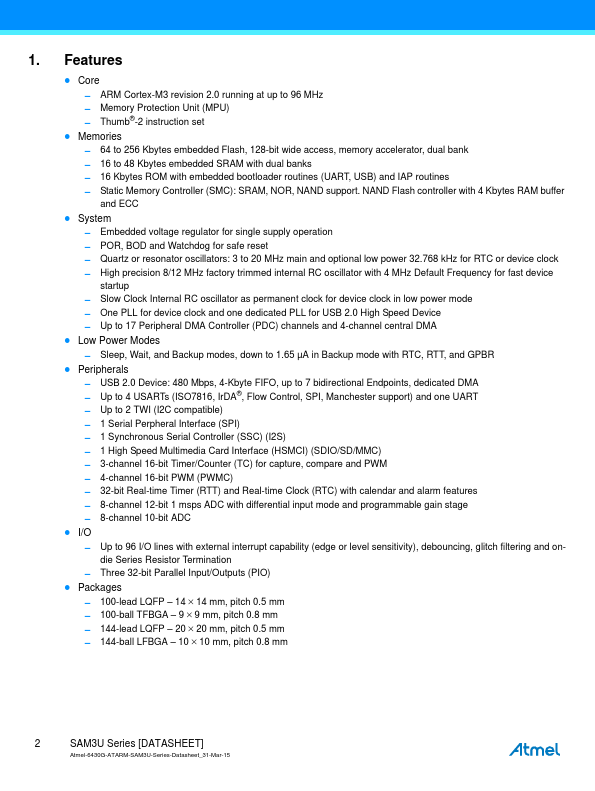
  • up to 256 Kbytes of Flash and up to 52 Kbytes of SRAM. The peripheral set includes a High Speed USB Device Port with embedded transceiver, a High Speed MCI for SDIO/SD/MMC, an External Bus Interface with NAND Flash controller, up to 4 USARTs, up to 2 TWIs, up to 5 SPIs, as well as 4 PWM timers, one 3-channel 16bit general-purpose timer, a low-power RTC, a 12-bit ADC and a 10-bit ADC. The SAM3U devices have three software-selectable low-power modes: Sleep, Wait, and Backup. In Sleep mode, the pro.

📥 Download Datasheet

Note: The manufacturer provides a single datasheet file (SAM3U-Atmel.pdf) that lists specifications for multiple related part numbers.

Full PDF Text Transcription (Reference)

The following content is an automatically extracted verbatim text from the original manufacturer datasheet and is provided for reference purposes only.

View original datasheet text
SAM3U Series Atmel | SMART ARM-based Flash MCU DATASHEET Description The Atmel® | SMART SAM3U series is a member of a family of Flash microcontrollers based on the high performance 32-bit ARM® Cortex®-M3 RISC processor. It operates at a maximum speed of 96 MHz and features up to 256 Kbytes of Flash and up to 52 Kbytes of SRAM. The peripheral set includes a High Speed USB Device Port with embedded transceiver, a High Speed MCI for SDIO/SD/MMC, an External Bus Interface with NAND Flash controller, up to 4 USARTs, up to 2 TWIs, up to 5 SPIs, as well as 4 PWM timers, one 3-channel 16bit general-purpose timer, a low-power RTC, a 12-bit ADC and a 10-bit ADC. The SAM3U devices have three software-selectable low-power modes: Sleep, Wait, and Backup.
Published: |