• Part: ADXL350
  • Description: Digital Accelerometer
  • Manufacturer: Analog Devices
  • Size: 0.98 MB
Download ADXL350 Datasheet PDF
Analog Devices
ADXL350
ADXL350 is Digital Accelerometer manufactured by Analog Devices.
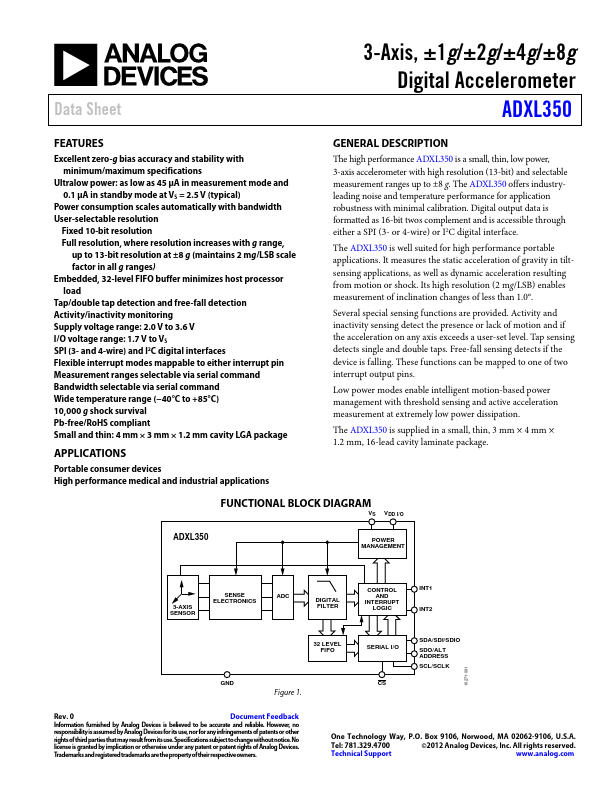
FEATURES Excellent zero-g bias accuracy and stability with minimum/maximum specifications Ultralow power: as low as 45 μA in measurement mode and 0.1 μA in standby mode at VS = 2.5 V (typical) Power consumption scales automatically with bandwidth User-selectable resolution Fixed 10-bit resolution Full resolution, where resolution increases with g range, up to 13-bit resolution at ±8 g (maintains 2 mg/LSB scale factor in all g ranges) Embedded, 32-level FIFO buffer minimizes host processor load Tap/double tap detection and free-fall detection Activity/inactivity monitoring Supply voltage range: 2.0 V to 3.6 V I/O voltage range: 1.7 V to VS SPI (3- and 4-wire) and I2C digital interfaces Flexible interrupt modes mappable to either interrupt pin Measurement ranges selectable via serial mand Bandwidth selectable via serial mand Wide temperature range (- 40°C to +85°C) 10,000 g shock survival Pb-free/Ro HS pliant Small and thin: 4 mm × 3 mm × 1.2 mm cavity LGA package 3-Axis, ±1g/±2g/±4g/±8g Digital Accelerometer ADXL350 GENERAL DESCRIPTION The high performance ADXL350 is a small, thin, low power, 3-axis accelerometer with high resolution (13-bit) and selectable measurement ranges up to ±8 g. The ADXL350 offers industryleading noise and temperature performance for application robustness with minimal calibration. Digital output data is formatted as 16-bit twos plement and is accessible through either a SPI (3- or 4-wire) or I2C digital interface. The ADXL350 is well suited for high performance portable applications. It measures the static acceleration of gravity in tiltsensing applications, as well as dynamic acceleration resulting from motion or shock. Its high resolution (2 mg/LSB) enables measurement of inclination changes of less than 1.0°. Several special sensing functions are provided. Activity and inactivity sensing detect the presence or lack of motion and if the acceleration on any axis exceeds a user-set level. Tap sensing detects single and double taps....