
• Part: ADXL343
  • Description: Digital MEMS Accelerometer
  • Manufacturer: Analog Devices
  • Size: 1.22 MB
Download ADXL343 Datasheet PDF
Analog Devices
ADXL343
ADXL343 is Digital MEMS Accelerometer manufactured by Analog Devices.
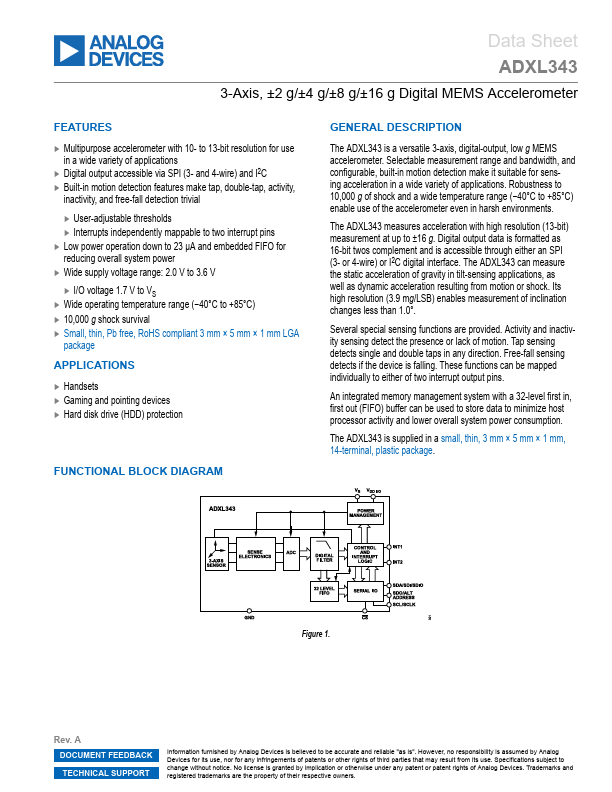
Data Sheet ADXL343 3-Axis, ±2 g/±4 g/±8 g/±16 g Digital MEMS Accelerometer Features - Multipurpose accelerometer with 10- to 13-bit resolution for use in a wide variety of applications - Digital output accessible via SPI (3- and 4-wire) and I2C - Built-in motion detection Features make tap, double-tap, activity, inactivity, and free-fall detection trivial - User-adjustable thresholds - Interrupts independently mappable to two interrupt pins - Low power operation down to 23 µA and embedded FIFO for reducing overall system power - Wide supply voltage range: 2.0 V to 3.6 V - I/O voltage 1.7 V to VS - Wide operating temperature range (- 40°C to +85°C) - 10,000 g shock survival - Small, thin, Pb free, Ro HS pliant 3 mm × 5 mm × 1 mm LGA package APPLICATIONS - Handsets - Gaming and pointing devices - Hard disk drive (HDD) protection FUNCTIONAL BLOCK DIAGRAM GENERAL DESCRIPTION The ADXL343 is a versatile 3-axis, digital-output, low g MEMS accelerometer. Selectable measurement range and bandwidth, and configurable, built-in motion detection make it suitable for sensing acceleration in a wide variety of applications. Robustness to 10,000 g of shock and a wide temperature range (- 40°C to +85°C) enable use of the accelerometer even in harsh environments. The ADXL343 measures acceleration with high resolution (13-bit) measurement at up to ±16 g. Digital output data is formatted as 16-bit twos plement and is accessible through either an SPI (3- or 4-wire) or I2C digital interface. The ADXL343 can measure the static acceleration of gravity in tilt-sensing applications, as well as dynamic acceleration resulting from motion or shock. Its high resolution (3.9 mg/LSB) enables measurement of inclination changes less than 1.0°. Several special sensing functions are provided. Activity and inactivity sensing detect the presence or lack of motion. Tap sensing detects single and double taps in any direction. Free-fall sensing detects if the device is falling. These functions can be...