
• Part: ADXL312
  • Description: Digital Accelerometer
  • Manufacturer: Analog Devices
  • Size: 1.05 MB
Download ADXL312 Datasheet PDF
Analog Devices
ADXL312
ADXL312 is Digital Accelerometer manufactured by Analog Devices.
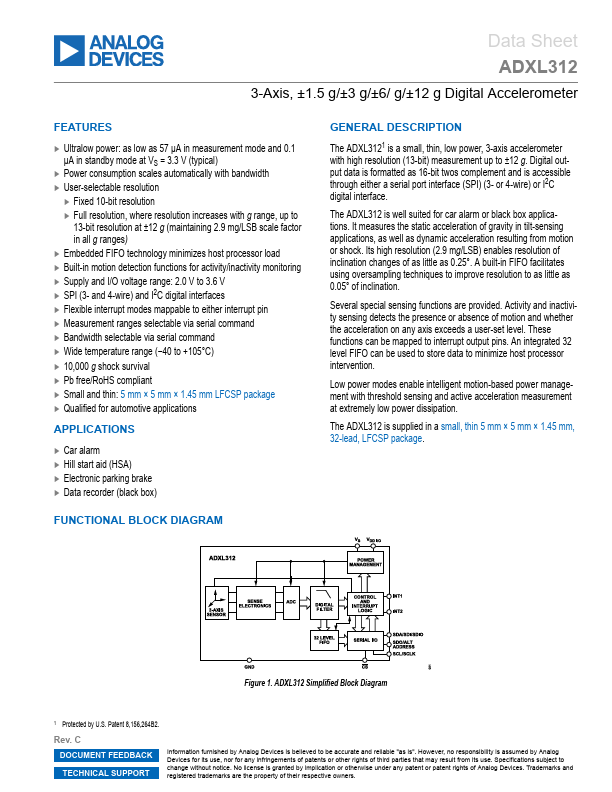
FEATURES - Ultralow power: as low as 57 µA in measurement mode and 0.1 µA in standby mode at VS = 3.3 V (typical) - Power consumption scales automatically with bandwidth - User-selectable resolution - Fixed 10-bit resolution - Full resolution, where resolution increases with g range, up to 13-bit resolution at ±12 g (maintaining 2.9 mg/LSB scale factor in all g ranges) - Embedded FIFO technology minimizes host processor load - Built-in motion detection functions for activity/inactivity monitoring - Supply and I/O voltage range: 2.0 V to 3.6 V - SPI (3- and 4-wire) and I2C digital interfaces - Flexible interrupt modes mappable to either interrupt pin - Measurement ranges selectable via serial mand - Bandwidth selectable via serial mand - Wide temperature range (- 40 to +105°C) - 10,000 g shock survival - Pb free/Ro HS pliant - Small and thin: 5 mm × 5 mm × 1.45 mm LFCSP package - Qualified for automotive applications APPLICATIONS - Car alarm - Hill start aid (HSA) - Electronic parking brake - Data recorder (black box) FUNCTIONAL BLOCK DIAGRAM GENERAL DESCRIPTION The ADXL3121 is a small, thin, low power, 3-axis accelerometer with high resolution (13-bit) measurement up to ±12 g. Digital output data is formatted as 16-bit twos plement and is accessible through either a serial port interface (SPI) (3- or 4-wire) or I2C digital interface. The ADXL312 is well suited for car alarm or black box applications. It measures the static acceleration of gravity in tilt-sensing applications, as well as dynamic acceleration resulting from motion or shock. Its high resolution (2.9 mg/LSB) enables resolution of inclination changes of as little as 0.25°. A built-in FIFO facilitates using oversampling techniques to improve resolution to as little as 0.05° of inclination. Several special sensing functions are provided. Activity and inactivity sensing detects the presence or absence of motion and whether the acceleration on any axis exceeds a user-set level. These functions can be mapped...