
ADV3222
ADV3222 is 4:1 Analog Multiplexer manufactured by Analog Devices.
- Part of the ADV3221 comparator family.
..
800 MHz, 4:1 Analog Multiplexer ADV3221/ADV3222
Features
Excellent ac performance
- 3 d B bandwidth 800 MHz (200 m V p-p) 750 MHz (2 V p-p) Slew rate: 2400 V/μs Low power: 75 m W, VS = ±5 V Excellent video performance 100 MHz, 0.1 d B gain flatness 0.02% differential gain error/0.02° differential phase error (RL = 150 Ω) ADV3221 is a pin-for-pin upgrade to the HA4344 Gain = +1 (ADV3221) or gain = +2 (ADV3222) Low all hostile crosstalk of
- 85 d B @ 5 MHz, and
- 58 d B @ 100 MHz Latched control lines for synchronous switching High impedance output disable allows connection of multiple devices without loading the output bus 16-lead SOIC
CS D
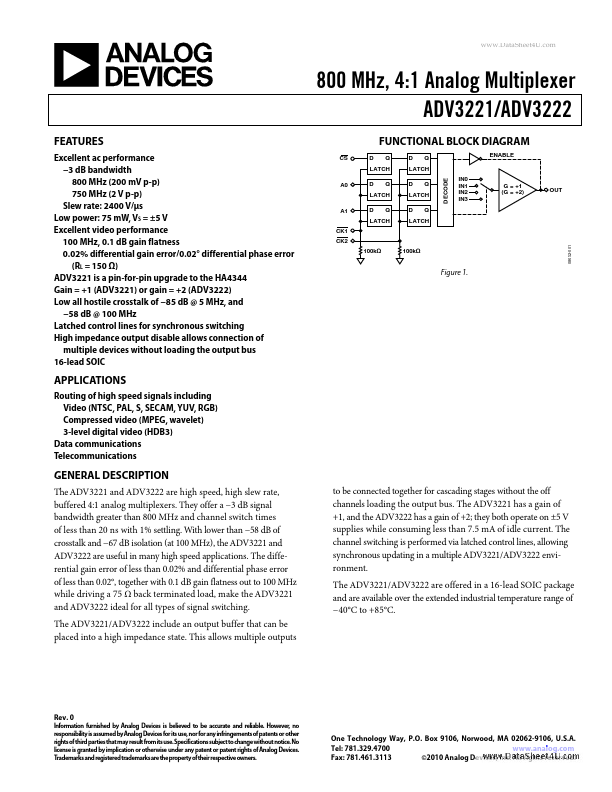
FUNCTIONAL BLOCK DIAGRAM
Q D Q ENABLE LATCH A0 D Q LATCH D Q
DECODE
LATCH A1 CK1 CK2 100kΩ D Q
LATCH D Q
IN0 IN1 IN2 IN3
G = +1 (G = +2)
LATCH
LATCH
100kΩ
Figure 1.
APPLICATIONS
Routing of high speed signals including Video (NTSC, PAL, S, SECAM, YUV, RGB) pressed video (MPEG, wavelet) 3-level digital video (HDB3) Data munications Telemunications
GENERAL DESCRIPTION
The ADV3221 and ADV3222 are high speed, high slew rate, buffered 4:1 analog multiplexers. They offer a
- 3 d B signal bandwidth greater than 800 MHz and channel switch times of less than 20 ns with 1% settling. With lower than
- 58 d B of crosstalk and
- 67 d B isolation (at 100 MHz), the ADV3221 and ADV3222 are useful in many high speed applications. The differential gain error of less than 0.02% and differential phase error of less than 0.02°, together with 0.1 d B gain flatness out to 100 MHz while driving a 75 Ω back terminated load, make the ADV3221 and ADV3222 ideal for all types of signal switching. The ADV3221/ADV3222 include an output buffer that can be placed into a high impedance state. This allows multiple outputs to be connected together for cascading stages without the off channels loading the output bus. The ADV3221 has a gain of +1, and the ADV3222 has a gain of +2; they both operate on ±5 V supplies while consuming less...