
Download ADP2360 Datasheet PDF
Analog Devices
ADP2360
ADP2360 is High Efficiency Buck Regulator manufactured by Analog Devices.
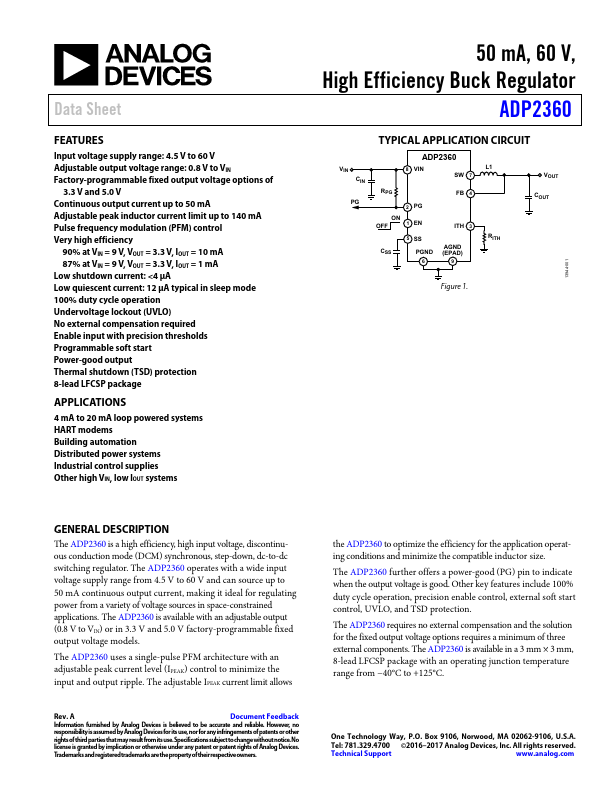
Data Sheet Features Input voltage supply range: 4.5 V to 60 V Adjustable output voltage range: 0.8 V to VIN Factory-programmable fixed output voltage options of 3.3 V and 5.0 V Continuous output current up to 50 m A Adjustable peak inductor current limit up to 140 m A Pulse frequency modulation (PFM) control Very high efficiency 90% at VIN = 9 V, VOUT = 3.3 V, IOUT = 10 m A 87% at VIN = 9 V, VOUT = 3.3 V, IOUT = 1 m A Low shutdown current: <4 μA Low quiescent current: 12 μA typical in sleep mode 100% duty cycle operation Undervoltage lockout (UVLO) No external pensation required Enable input with precision thresholds Programmable soft start Power-good output Thermal shutdown (TSD) protection 8-lead LFCSP package APPLICATIONS 4 m A to 20 m A loop powered systems HART modems Building automation Distributed power systems Industrial control supplies Other high VIN, low IOUT systems 50 m A, 60 V, High Efficiency Buck Regulator VIN CIN TYPICAL APPLICATION CIRCUIT 8 VIN SW 7 L1 VOUT 2 PG 1 EN 5 SS CSS PGND FB 4 ITH 3 AGND (EPAD) RITH COUT 13944-001 Figure 1. GENERAL DESCRIPTION The ADP2360 is a high efficiency, high input voltage, discontinuous conduction mode (DCM) synchronous, step-down, dc-to-dc switching regulator. The ADP2360 operates with a wide input voltage supply range from 4.5 V to 60 V and can source up to 50 m A continuous output current, making it ideal for regulating power from a variety of voltage sources in space-constrained applications. The ADP2360 is available with an adjustable output (0.8 V to VIN) or in 3.3 V and 5.0 V factory-programmable fixed output voltage models. The ADP2360 uses a single-pulse PFM architecture with an adjustable peak current level (IPEAK) control to minimize the input and output ripple. The adjustable IPEAK current limit allows Rev. A Document Feedback Information furnished by Analog Devices is believed to be accurate and reliable. However, no responsibility is assumed by...