
AD9267
AD9267 is 640 MSPS Dual Continuous Time Sigma-Delta Modulator manufactured by Analog Devices.
FEATURES
SNR: 83 d B (85 d BFS) to 10 MHz input SFDR:
- 88 d Bc to 10 MHz input Noise figure: 15 d B Input impedance: 1 kΩ Power: 416 m W 10 MHz real or 20 MHz plex bandwidth 1.8 V analog supply operation On-chip PLL clock multiplier On-chip voltage reference Twos plement data format 640 MSPS, 4-bit LVDS data output Serial control interface (SPI)
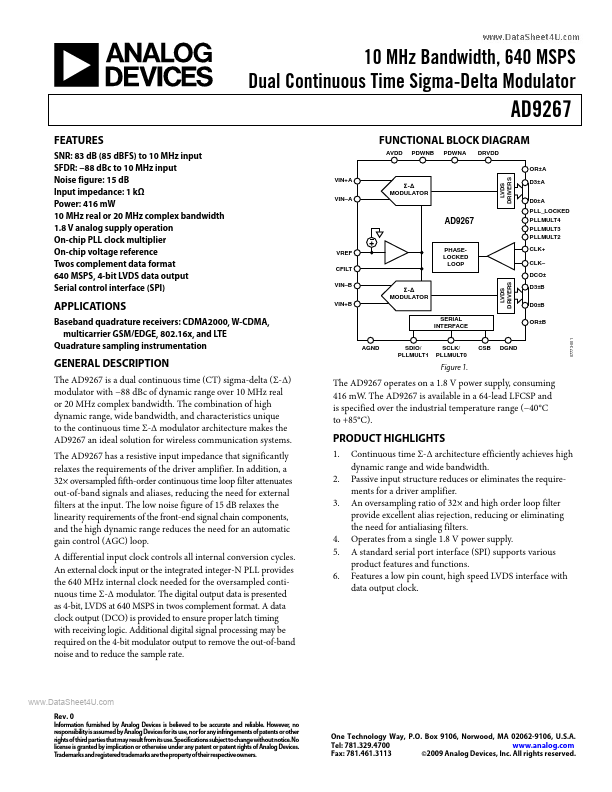
FUNCTIONAL BLOCK DIAGRAM
AVDD PDWNB PDWNA DRVDD OR±A VIN+A VIN- A
LVDS DRIVERS
Σ -Δ MODULATOR
D3±A D0±A PLL_LOCKED PLLMULT4 PLLMULT3 PLLMULT2 CLK+ CLK- DCO±
VREF CFILT VIN- B VIN+B Σ -Δ MODULATOR
PHASELOCKED LOOP
LVDS DRIVERS
D3±B D0±B OR±B
07773-001
APPLICATIONS
Baseband quadrature receivers: CDMA2000, W-CDMA, multicarrier GSM/EDGE, 802.16x, and LTE Quadrature sampling instrumentation
SERIAL INTERFACE
AGND
SDIO/ PLLMULT1
SCLK/ PLLMULT0
DGND
GENERAL DESCRIPTION
The AD9267 is a dual continuous time (CT) sigma-delta (Σ-Δ) modulator with
- 88 d Bc of dynamic range over 10 MHz real or 20 MHz plex bandwidth. The bination of high dynamic range, wide bandwidth, and characteristics unique to the continuous time Σ-Δ modulator architecture makes the AD9267 an ideal solution for wireless munication systems. The AD9267 has a resistive input impedance that significantly relaxes the requirements of the driver amplifier. In addition, a 32× oversampled fifth-order continuous time loop filter attenuates out-of-band signals and aliases, reducing the need for external filters at the input. The low noise figure of 15 d B relaxes the linearity requirements of the front-end signal chain ponents, and the high dynamic range reduces the need for an automatic gain control (AGC) loop. A differential input clock controls all internal conversion cycles. An external clock input or the integrated integer-N PLL provides the 640 MHz internal clock needed for the oversampled continuous time Σ-Δ modulator. The digital output data is presented as 4-bit, LVDS at 640 MSPS in twos plement format. A data clock output (DCO) is provided to ensure...